

Resources
Guides, research, and perspectives on R&D intelligence, IP strategy, and the future of AI enabled innovation.

Executive Summary
In 2024, US patent infringement jury verdicts totaled $4.19 billion across 72 cases. Twelve individual verdicts exceeded $100million. The largest single award—$857 million in General Access Solutions v.Cellco Partnership (Verizon)—exceeded the annual R&D budget of many mid-market technology companies. In the first half of 2025 alone, total damages reached an additional $1.91 billion.
The consequences of incomplete patent intelligence are not abstract. In what has become one of the most instructive IP disputes in recent history, Masimo’s pulse oximetry patents triggered a US import ban on certain Apple Watch models, forcing Apple to disable its blood oxygen feature across an entire product line, halt domestic sales of affected models, invest in a hardware redesign, and ultimately face a $634 million jury verdict in November 2025. Apple—a company with one of the most sophisticated intellectual property organizations on earth—spent years in litigation over technology it might have designed around during development.
For organizations with fewer resources than Apple, the risk calculus is starker. A mid-size materials company, a university spinout, or a defense contractor developing next-generation battery technology cannot absorb a nine-figure verdict or a multi-year injunction. For these organizations, the patent landscape analysis conducted during the development phase is the primary risk mitigation mechanism. The quality of that analysis is not a matter of convenience. It is a matter of survival.
And yet, a growing number of R&D and IP teams are conducting that analysis using general-purpose AI tools—ChatGPT, Claude, Microsoft Co-Pilot—that were never designed for patent intelligence and are structurally incapable of delivering it.
This report presents the findings of a controlled comparison study in which identical patent landscape queries were submitted to four AI-powered tools: Cypris (a purpose-built R&D intelligence platform),ChatGPT (OpenAI), Claude (Anthropic), and Microsoft Co-Pilot. Two technology domains were tested: solid-state lithium-sulfur battery electrolytes using garnet-type LLZO ceramic materials (freedom-to-operate analysis), and bio-based polyamide synthesis from castor oil derivatives (competitive intelligence).
The results reveal a significant and structurally persistent gap. In Test 1, Cypris identified over 40 active US patents and published applications with granular FTO risk assessments. Claude identified 12. ChatGPT identified 7, several with fabricated attribution. Co-Pilot identified 4. Among the patents surfaced exclusively by Cypris were filings rated as “Very High” FTO risk that directly claim the technology architecture described in the query. In Test 2, Cypris cited over 100 individual patent filings with full attribution to substantiate its competitive landscape rankings. No general-purpose model cited a single patent number.
The most active sectors for patent enforcement—semiconductors, AI, biopharma, and advanced materials—are the same sectors where R&D teams are most likely to adopt AI tools for intelligence workflows. The findings of this report have direct implications for any organization using general-purpose AI to inform patent strategy, competitive intelligence, or R&D investment decisions.

1. Methodology
A single patent landscape query was submitted verbatim to each tool on March 27, 2026. No follow-up prompts, clarifications, or iterative refinements were provided. Each tool received one opportunity to respond, mirroring the workflow of a practitioner running an initial landscape scan.
1.1 Query
Identify all active US patents and published applications filed in the last 5 years related to solid-state lithium-sulfur battery electrolytes using garnet-type ceramic materials. For each, provide the assignee, filing date, key claims, and current legal status. Highlight any patents that could pose freedom-to-operate risks for a company developing a Li₇La₃Zr₂O₁₂(LLZO)-based composite electrolyte with a polymer interlayer.
1.2 Tools Evaluated

1.3 Evaluation Criteria
Each response was assessed across six dimensions: (1) number of relevant patents identified, (2) accuracy of assignee attribution,(3) completeness of filing metadata (dates, legal status), (4) depth of claim analysis relative to the proposed technology, (5) quality of FTO risk stratification, and (6) presence of actionable design-around or strategic guidance.
2. Findings
2.1 Coverage Gap
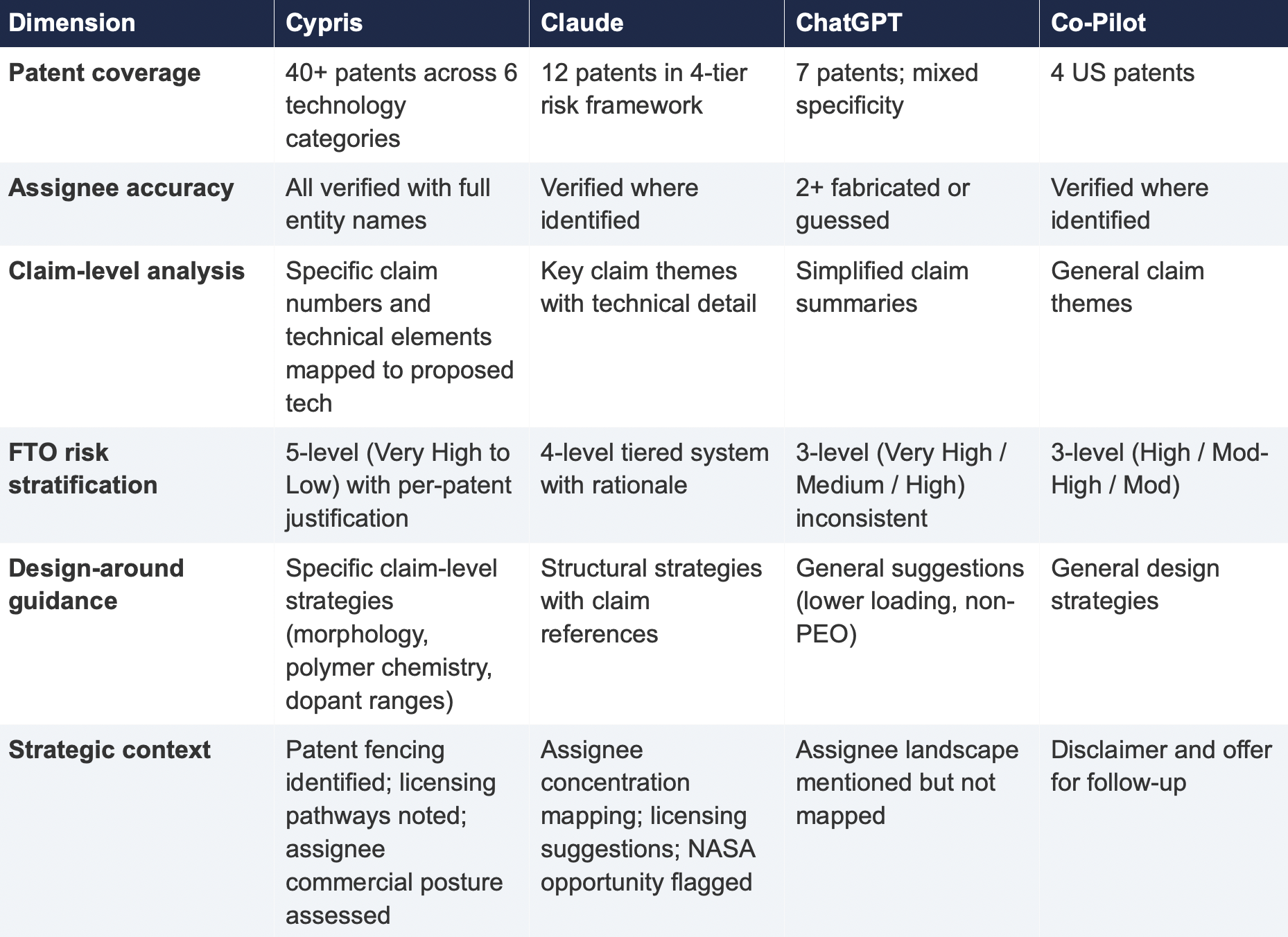
The most significant finding is the scale of the coverage differential. Cypris identified over 40 active US patents and published applications spanning LLZO-polymer composite electrolytes, garnet interface modification, polymer interlayer architectures, lithium-sulfur specific filings, and adjacent ceramic composite patents. The results were organized by technology category with per-patent FTO risk ratings.
Claude identified 12 patents organized in a four-tier risk framework. Its analysis was structurally sound and correctly flagged the two highest-risk filings (Solid Energies US 11,967,678 and the LLZO nanofiber multilayer US 11,923,501). It also identified the University ofMaryland/ Wachsman portfolio as a concentration risk and noted the NASA SABERS portfolio as a licensing opportunity. However, it missed the majority of the landscape, including the entire Corning portfolio, GM's interlayer patents, theKorea Institute of Energy Research three-layer architecture, and the HonHai/SolidEdge lithium-sulfur specific filing.
ChatGPT identified 7 patents, but the quality of attribution was inconsistent. It listed assignees as "Likely DOE /national lab ecosystem" and "Likely startup / defense contractor cluster" for two filings—language that indicates the model was inferring rather than retrieving assignee data. In a freedom-to-operate context, an unverified assignee attribution is functionally equivalent to no attribution, as it cannot support a licensing inquiry or risk assessment.
Co-Pilot identified 4 US patents. Its output was the most limited in scope, missing the Solid Energies portfolio entirely, theUMD/ Wachsman portfolio, Gelion/ Johnson Matthey, NASA SABERS, and all Li-S specific LLZO filings.
2.2 Critical Patents Missed by Public Models
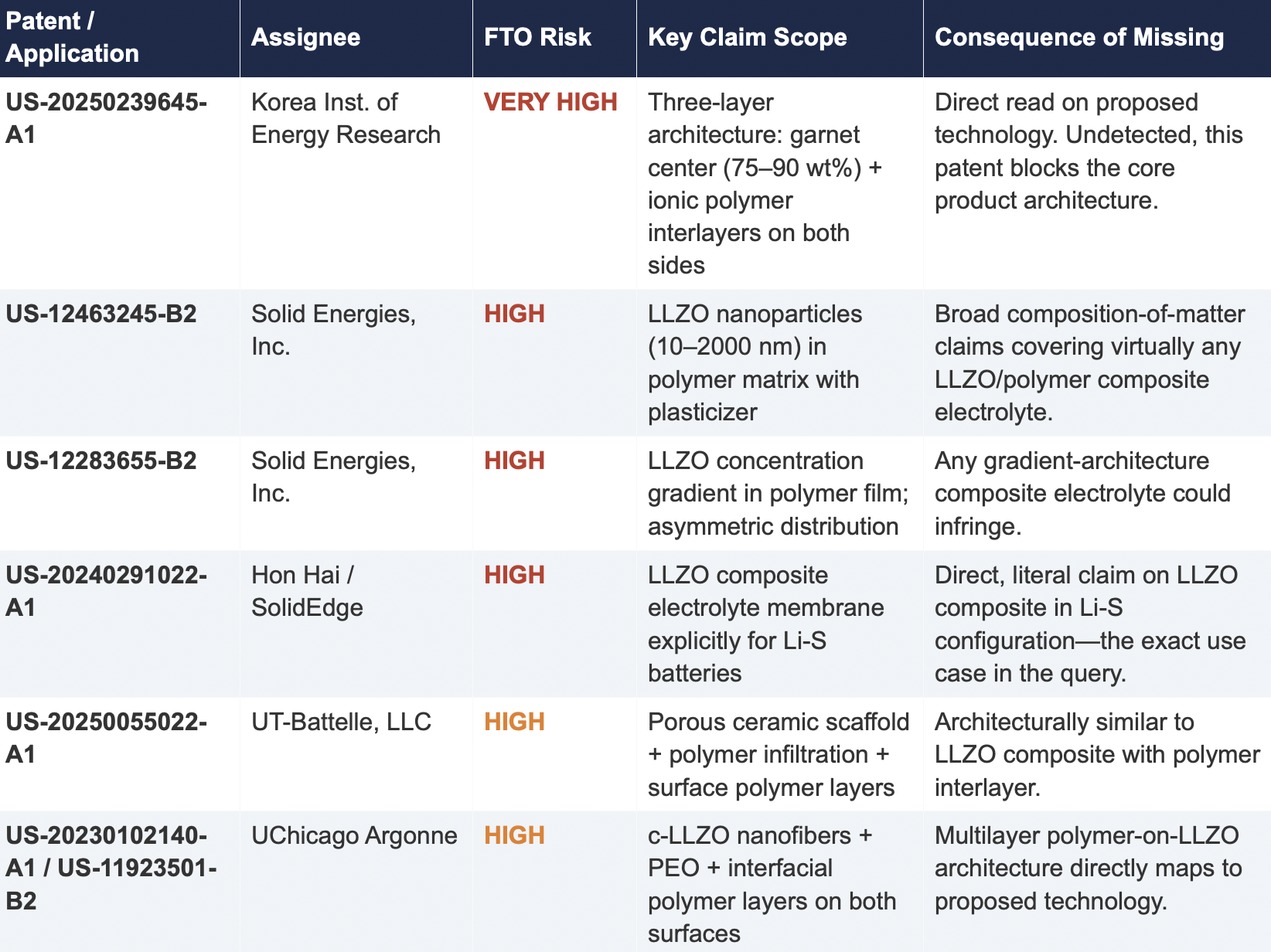
The following table presents patents identified exclusively by Cypris that were rated as High or Very High FTO risk for the proposed technology architecture. None were surfaced by any general-purpose model.
2.3 Patent Fencing: The Solid Energies Portfolio
Cypris identified a coordinated patent fencing strategy by Solid Energies, Inc. that no general-purpose model detected at scale. Solid Energies holds at least four granted US patents and one published application covering LLZO-polymer composite electrolytes across compositions(US-12463245-B2), gradient architectures (US-12283655-B2), electrode integration (US-12463249-B2), and manufacturing processes (US-20230035720-A1). Claude identified one Solid Energies patent (US 11,967,678) and correctly rated it as the highest-priority FTO concern but did not surface the broader portfolio. ChatGPT and Co-Pilot identified zero Solid Energies filings.
The practical significance is that a company relying on any individual patent hit would underestimate the scope of Solid Energies' IP position. The fencing strategy—covering the composition, the architecture, the electrode integration, and the manufacturing method—means that identifying a single design-around for one patent does not resolve the FTO exposure from the portfolio as a whole. This is the kind of strategic insight that requires seeing the full picture, which no general-purpose model delivered
2.4 Assignee Attribution Quality
ChatGPT's response included at least two instances of fabricated or unverifiable assignee attributions. For US 11,367,895 B1, the listed assignee was "Likely startup / defense contractor cluster." For US 2021/0202983 A1, the assignee was described as "Likely DOE / national lab ecosystem." In both cases, the model appears to have inferred the assignee from contextual patterns in its training data rather than retrieving the information from patent records.
In any operational IP workflow, assignee identity is foundational. It determines licensing strategy, litigation risk, and competitive positioning. A fabricated assignee is more dangerous than a missing one because it creates an illusion of completeness that discourages further investigation. An R&D team receiving this output might reasonably conclude that the landscape analysis is finished when it is not.
3. Structural Limitations of General-Purpose Models for Patent Intelligence
3.1 Training Data Is Not Patent Data
Large language models are trained on web-scraped text. Their knowledge of the patent record is derived from whatever fragments appeared in their training corpus: blog posts mentioning filings, news articles about litigation, snippets of Google Patents pages that were crawlable at the time of data collection. They do not have systematic, structured access to the USPTO database. They cannot query patent classification codes, parse claim language against a specific technology architecture, or verify whether a patent has been assigned, abandoned, or subjected to terminal disclaimer since their training data was collected.
This is not a limitation that improves with scale. A larger training corpus does not produce systematic patent coverage; it produces a larger but still arbitrary sampling of the patent record. The result is that general-purpose models will consistently surface well-known patents from heavily discussed assignees (QuantumScape, for example, appeared in most responses) while missing commercially significant filings from less publicly visible entities (Solid Energies, Korea Institute of EnergyResearch, Shenzhen Solid Advanced Materials).
3.2 The Web Is Closing to Model Scrapers
The data access problem is structural and worsening. As of mid-2025, Cloudflare reported that among the top 10,000 web domains, the majority now fully disallow AI crawlers such as GPTBot andClaudeBot via robots.txt. The trend has accelerated from partial restrictions to outright blocks, and the crawl-to-referral ratios reveal the underlying tension: OpenAI's crawlers access approximately1,700 pages for every referral they return to publishers; Anthropic's ratio exceeds 73,000 to 1.
Patent databases, scientific publishers, and IP analytics platforms are among the most restrictive content categories. A Duke University study in 2025 found that several categories of AI-related crawlers never request robots.txt files at all. The practical consequence is that the knowledge gap between what a general-purpose model "knows" about the patent landscape and what actually exists in the patent record is widening with each training cycle. A landscape query that a general-purpose model partially answered in 2023 may return less useful information in 2026.
3.3 General-Purpose Models Lack Ontological Frameworks for Patent Analysis
A freedom-to-operate analysis is not a summarization task. It requires understanding claim scope, prosecution history, continuation and divisional chains, assignee normalization (a single company may appear under multiple entity names across patent records), priority dates versus filing dates versus publication dates, and the relationship between dependent and independent claims. It requires mapping the specific technical features of a proposed product against independent claim language—not keyword matching.
General-purpose models do not have these frameworks. They pattern-match against training data and produce outputs that adopt the format and tone of patent analysis without the underlying data infrastructure. The format is correct. The confidence is high. The coverage is incomplete in ways that are not visible to the user.
4. Comparative Output Quality
The following table summarizes the qualitative characteristics of each tool's response across the dimensions most relevant to an operational IP workflow.
5. Implications for R&D and IP Organizations
5.1 The Confidence Problem
The central risk identified by this study is not that general-purpose models produce bad outputs—it is that they produce incomplete outputs with high confidence. Each model delivered its results in a professional format with structured analysis, risk ratings, and strategic recommendations. At no point did any model indicate the boundaries of its knowledge or flag that its results represented a fraction of the available patent record. A practitioner receiving one of these outputs would have no signal that the analysis was incomplete unless they independently validated it against a comprehensive datasource.
This creates an asymmetric risk profile: the better the format and tone of the output, the less likely the user is to question its completeness. In a corporate environment where AI outputs are increasingly treated as first-pass analysis, this dynamic incentivizes under-investigation at precisely the moment when thoroughness is most critical.
5.2 The Diversification Illusion
It might be assumed that running the same query through multiple general-purpose models provides validation through diversity of sources. This study suggests otherwise. While the four tools returned different subsets of patents, all operated under the same structural constraints: training data rather than live patent databases, web-scraped content rather than structured IP records, and general-purpose reasoning rather than patent-specific ontological frameworks. Running the same query through three constrained tools does not produce triangulation; it produces three partial views of the same incomplete picture.
5.3 The Appropriate Use Boundary
General-purpose language models are effective tools for a wide range of tasks: drafting communications, summarizing documents, generating code, and exploratory research. The finding of this study is not that these tools lack value but that their value boundary does not extend to decisions that carry existential commercial risk.
Patent landscape analysis, freedom-to-operate assessment, and competitive intelligence that informs R&D investment decisions fall outside that boundary. These are workflows where the completeness and verifiability of the underlying data are not merely desirable but are the primary determinant of whether the analysis has value. A patent landscape that captures 10% of the relevant filings, regardless of how well-formatted or confidently presented, is a liability rather than an asset.
6. Test 2: Competitive Intelligence — Bio-Based Polyamide Patent Landscape
To assess whether the findings from Test 1 were specific to a single technology domain or reflected a broader structural pattern, a second query was submitted to all four tools. This query shifted from freedom-to-operate analysis to competitive intelligence, asking each tool to identify the top 10organizations by patent filing volume in bio-based polyamide synthesis from castor oil derivatives over the past three years, with summaries of technical approach, co-assignee relationships, and portfolio trajectory.
6.1 Query

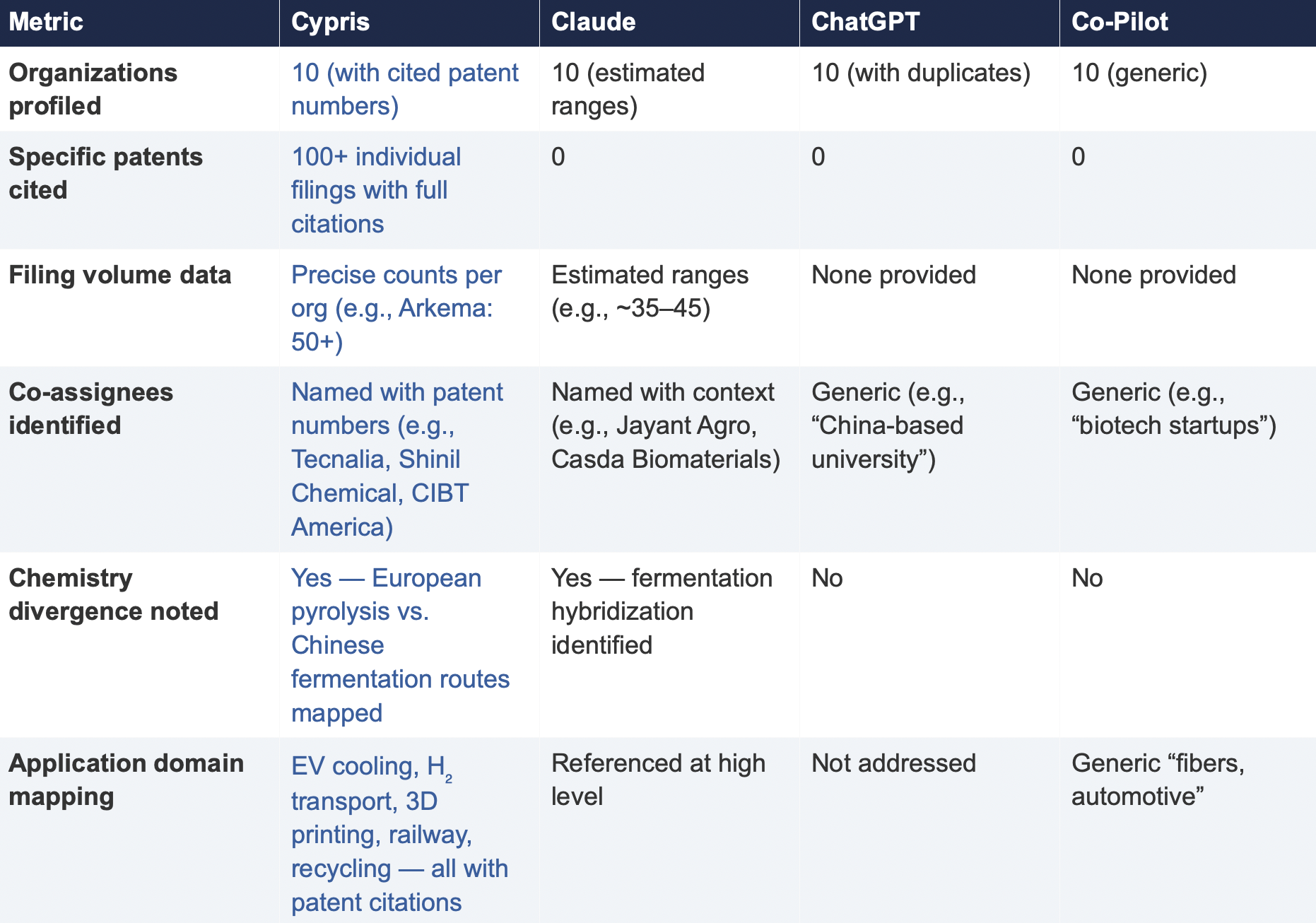
6.2 Summary of Results
6.3 Key Differentiators
Verifiability
The most consequential difference in Test 2 was the presence or absence of verifiable evidence. Cypris cited over 100 individual patent filings with full patent numbers, assignee names, and publication dates. Every claim about an organization’s technical focus, co-assignee relationships, and filing trajectory was anchored to specific documents that a practitioner could independently verify in USPTO, Espacenet, or WIPO PATENT SCOPE. No general-purpose model cited a single patent number. Claude produced the most structured and analytically useful output among the public models, with estimated filing ranges, product names, and strategic observations that were directionally plausible. However, without underlying patent citations, every claim in the response requires independent verification before it can inform a business decision. ChatGPT and Co-Pilot offered thinner profiles with no filing counts and no patent-level specificity.
Data Integrity
ChatGPT’s response contained a structural error that would mislead a practitioner: it listed CathayBiotech as organization #5 and then listed “Cathay Affiliate Cluster” as a separate organization at #9, effectively double-counting a single entity. It repeated this pattern with Toray at #4 and “Toray(Additional Programs)” at #10. In a competitive intelligence context where the ranking itself is the deliverable, this kind of error distorts the landscape and could lead to misallocation of competitive monitoring resources.
Organizations Missed
Cypris identified Kingfa Sci. & Tech. (8–10 filings with a differentiated furan diacid-based polyamide platform) and Zhejiang NHU (4–6 filings focused on continuous polymerization process technology)as emerging players that no general-purpose model surfaced. Both represent potential competitive threats or partnership opportunities that would be invisible to a team relying on public AI tools.Conversely, ChatGPT included organizations such as ANTA and Jiangsu Taiji that appear to be downstream users rather than significant patent filers in synthesis, suggesting the model was conflating commercial activity with IP activity.
Strategic Depth
Cypris’s cross-cutting observations identified a fundamental chemistry divergence in the landscape:European incumbents (Arkema, Evonik, EMS) rely on traditional castor oil pyrolysis to 11-aminoundecanoic acid or sebacic acid, while Chinese entrants (Cathay Biotech, Kingfa) are developing alternative bio-based routes through fermentation and furandicarboxylic acid chemistry.This represents a potential long-term disruption to the castor oil supply chain dependency thatWestern players have built their IP strategies around. Claude identified a similar theme at a higher level of abstraction. Neither ChatGPT nor Co-Pilot noted the divergence.
6.4 Test 2 Conclusion
Test 2 confirms that the coverage and verifiability gaps observed in Test 1 are not domain-specific.In a competitive intelligence context—where the deliverable is a ranked landscape of organizationalIP activity—the same structural limitations apply. General-purpose models can produce plausible-looking top-10 lists with reasonable organizational names, but they cannot anchor those lists to verifiable patent data, they cannot provide precise filing volumes, and they cannot identify emerging players whose patent activity is visible in structured databases but absent from the web-scraped content that general-purpose models rely on.
7. Conclusion
This comparative analysis, spanning two distinct technology domains and two distinct analytical workflows—freedom-to-operate assessment and competitive intelligence—demonstrates that the gap between purpose-built R&D intelligence platforms and general-purpose language models is not marginal, not domain-specific, and not transient. It is structural and consequential.
In Test 1 (LLZO garnet electrolytes for Li-S batteries), the purpose-built platform identified more than three times as many patents as the best-performing general-purpose model and ten times as many as the lowest-performing one. Among the patents identified exclusively by the purpose-built platform were filings rated as Very High FTO risk that directly claim the proposed technology architecture. InTest 2 (bio-based polyamide competitive landscape), the purpose-built platform cited over 100individual patent filings to substantiate its organizational rankings; no general-purpose model cited as ingle patent number.
The structural drivers of this gap—reliance on training data rather than live patent feeds, the accelerating closure of web content to AI scrapers, and the absence of patent-specific analytical frameworks—are not transient. They are inherent to the architecture of general-purpose models and will persist regardless of increases in model capability or training data volume.
For R&D and IP leaders, the practical implication is clear: general-purpose AI tools should be used for general-purpose tasks. Patent intelligence, competitive landscaping, and freedom-to-operate analysis require purpose-built systems with direct access to structured patent data, domain-specific analytical frameworks, and the ability to surface what a general-purpose model cannot—not because it chooses not to, but because it structurally cannot access the data.
The question for every organization making R&D investment decisions today is whether the tools informing those decisions have access to the evidence base those decisions require. This study suggests that for the majority of general-purpose AI tools currently in use, the answer is no.
About This Report
This report was produced by Cypris (IP Web, Inc.), an AI-powered R&D intelligence platform serving corporate innovation, IP, and R&D teams at organizations including NASA, Johnson & Johnson, theUS Air Force, and Los Alamos National Laboratory. Cypris aggregates over 500 million data points from patents, scientific literature, grants, corporate filings, and news to deliver structured intelligence for technology scouting, competitive analysis, and IP strategy.
The comparative tests described in this report were conducted on March 27, 2026. All outputs are preserved in their original form. Patent data cited from the Cypris reports has been verified against USPTO Patent Center and WIPO PATENT SCOPE records as of the same date. To conduct a similar analysis for your technology domain, contact info@cypris.ai or visit cypris.ai.
The Patent Intelligence Gap - A Comparative Analysis of Verticalized AI-Patent Tools vs. General-Purpose Language Models for R&D Decision-Making
Blogs

From Co-Pilot to Lab-Pilot: How Agentic AI is Redefining Chemical R&D
This article was powered by Cypris Q, an AI agent that helps R&D teams instantly synthesize insights from patents, scientific literature, and market intelligence from around the globe. Discover how leading R&D teams use Cypris Q to monitor technology landscapes and identify opportunities faster - Book a demo
Executive Summary
The chemical industry is at an inflection point. After three years of reduced demand and intensifying global competition, the sector has effectively undone 20 years of outsized market performance [1]. Structural overcapacity in major value chains, combined with a modest demand outlook, is exerting sustained pressure on margins [1]. In this environment, R&D leaders are being asked to do more with less, compressing innovation cycles that traditionally span a decade while simultaneously cutting costs.
The answer emerging from the most forward-thinking organizations is not simply "more AI," but a fundamentally different kind of AI. The industry is transitioning from passive, prompt-driven "Generative AI" tools to autonomous "Agentic AI" systems capable of proactively planning, reasoning, and managing multi-step scientific workflows with minimal human oversight [2, 3, 4]. This shift represents what one leading researcher has called the "co-pilot to lab-pilot" transition, a paradigm where AI no longer merely interprets knowledge but increasingly acts upon it [4].
This article examines the real-world deployments of agentic AI in chemical R&D, analyzes the patent landscape revealing major players' strategic investments, and provides actionable recommendations for corporate R&D leaders navigating this transformation.
The Agentic Difference: From Answering Questions to Running Experiments
The distinction between generative and agentic AI is critical for R&D leaders to understand. Generative AI, exemplified by large language models, excels at creating original content by learning from large datasets. It is fundamentally reactive, responding to user prompts [3]. Agentic AI, by contrast, executes goal-driven tasks autonomously within specific environments by perceiving inputs and making decisions in real time [3]. The most advanced agentic AI systems go further still, proactively planning and managing multi-step workflows to achieve long-term goals with minimal human intervention [3].
A comprehensive review in Chemical Science examining the role of LLMs and autonomous agents in chemistry found that these systems are now being deployed for molecule design, property prediction, and synthesis automation [5]. The implications for R&D are profound. Instead of a scientist asking an AI to "suggest a molecule with property X," an agentic system can autonomously design the molecule, plan the synthesis, execute the experiment via robotic hardware, analyze the results, and iterate, all without human intervention between steps.
Real-World Deployments: From Pilot to Production
This is not a theoretical future. A landmark review in Chemical Reviews, which has been cited 165 times since its publication in August 2024, provides a comprehensive analysis of "Self-Driving Laboratories" that are already operational across drug discovery, materials science, genomics, and chemistry [6]. The review documents how the automation of experimental workflows, combined with autonomous experimental planning, is accelerating research timelines.
Case Study: LUMI-lab and Lipid Nanoparticle Discovery
One of the most striking recent examples is LUMI-lab, a self-driving laboratory platform that integrates a molecular foundation model with an automated active-learning experimental workflow [7]. Through ten iterative cycles, LUMI-lab synthesized and evaluated over 1,700 lipid nanoparticles for mRNA delivery [7]. The system autonomously identified ionizable lipids with superior mRNA transfection potency compared to clinically approved benchmarks [7]. Unexpectedly, it also discovered brominated lipid tails as a novel feature enhancing mRNA delivery, a finding that emerged from the AI's autonomous exploration, not from human hypothesis [7]. In vivo validation confirmed that the top-performing lipid achieved 20.3% gene editing efficacy in lung epithelial cells, surpassing the highest efficiency reported for inhaled LNP-mediated CRISPR-Cas9 delivery in mice [7].
Case Study: Autonomous Reaction Pareto-Front Mapping
In catalysis, a self-driving laboratory at North Carolina State University demonstrated autonomous reaction Pareto-front mapping for hydroformylation reactions [8]. The system, developed in collaboration with Eastman Chemical Company, autonomously optimized multiple competing objectives including yield, selectivity, and throughput without human intervention, identifying optimal operating conditions that would have taken months to discover through traditional experimentation [8].
Case Study: Fleming for Antibiotic Discovery
In pharmaceutical R&D, the "Fleming" AI agent was introduced for tuberculosis antibiotic discovery [9]. The system orchestrates four specialized agents, including a bacterial inhibition prediction agent, a molecular generation agent, a molecular optimization agent, and an ADMET agent, to perform key tasks in early drug discovery [9]. Using the largest curated dataset of TB inhibitors to date with 114,933 compounds, Fleming mirrors the decision-making of medicinal chemists through a natural language interface [9].
The IP Landscape: Major Players Are Betting Big
Patent activity from major chemical companies confirms that this is not a fringe trend. Analysis of recent filings through the Cypris platform reveals significant investment in AI-driven R&D automation.
BASF has patented a protein engineering pipeline that combines a protein design workflow with evaluation procedures performed on a quantum computer, enabling the prediction of amino acid substitutions to generate optimized protein variants [10, 11]. Dow Global Technologies has filed multiple patents on "Hybrid Machine Learning Methods" for training models to predict formulation properties, including methods for feature selection, model validation, and deployment of trained ML modules to predict chemical product attributes without physical production [12, 13, 14]. SABIC has patented an AI-based process control system that uses trained models to derive optimal reactor input conditions for achieving target product properties, with automated data correction to remove abnormal values from training data [15, 16].
These filings represent a strategic shift. Major chemical companies are not just using AI tools, they are building proprietary AI infrastructure as a core competitive asset.
The Productivity Imperative: Why Now?
The timing of this transition is not coincidental. According to McKinsey's analysis, the chemical industry's total shareholder return from performance alone has been just 1.6% per year over the past five years, with growth more than offset by heavy capital investments and decreasing margins [1]. In this environment, AI-enabled performance is quickly becoming the new baseline [1].
Leading companies are already deploying hundreds or even thousands of AI agents to automate workflows [1]. The productivity impact is growing across all areas. In R&D, AI is accelerating molecule discovery and formulation optimization, doubling rates in some cases, and enabling knowledge extraction from over 15 million patents [1]. In commercial functions, generative AI is opening new avenues for lead generation and cross-sell opportunities, with some applications resulting in a two- to threefold increase in the sales pipeline [1]. In operations, AI use cases are reducing costs and increasing efficiency by optimizing predictive maintenance, energy consumption, and supply chain management [1].
A diversified chemicals producer reported implementing nearly 500 AI models across operations, with over 40% of facilities using AI-powered tools for real-time insights and automated control [17]. Recent deployments include optimizing ethylene distribution and improving asset utilization, with reported improvements in safety compliance and reduced energy consumption [17].
The "Frugal Twin" Opportunity: Democratizing Access
One of the most significant developments for mid-sized chemical companies is the emergence of low-cost self-driving laboratory platforms. A review of the "frugal twin" concept found that low-cost FDM 3D printing can transform consumer 3D printers into automated lab equipment, including liquid handlers, imaging devices, robotic arms, and bioprinters, cutting costs by 90 to 99 percent versus commercial alternatives [18, 19].
This democratization is critical because, as a community survey on autonomous laboratories found, the barriers to adoption are not purely technical [20]. The survey highlighted a variety of researcher challenges and motivations, and proposed a framework for "levels of laboratory autonomy" from L0 representing fully manual operations to L5 representing fully autonomous systems [20]. Most organizations today operate at L1 to L2, with significant opportunities to advance.
Recommendations for Corporate R&D Leaders
Based on the evidence from recent research, patent activity, and industry deployments, R&D leaders should consider the following strategic actions.
Adopt a "Through-Cycle" Investment Mindset
The best-performing companies maintain or even accelerate high-impact investments during industry troughs [1]. Rather than cutting R&D budgets reactively, leaders should identify specific AI initiatives that can compress innovation timelines and reduce cost-per-experiment. The LUMI-lab example demonstrates that AI-driven platforms can achieve in ten iterative cycles what might take years of traditional experimentation [7].
Prioritize Data Infrastructure Over Model Sophistication
The success of agentic systems depends fundamentally on data quality. Companies should prioritize cleansing and digitizing disparate experimental datasets that have historically been siloed or poorly maintained [21]. Recent advances in Quantum Molecular Structure Encoding demonstrate that how data is represented to AI systems can dramatically improve model performance [22]. Investing in data infrastructure now will pay dividends as AI capabilities continue to advance.
Start with "Frugal Twins" Before Scaling
Low-cost self-driving labs offer faster prototyping, low-risk hands-on experience, and a test bed for sophisticated experimental planning software [19]. Organizations should consider piloting autonomous workflows on lower-stakes projects before committing to enterprise-scale deployments. This approach allows teams to build institutional knowledge and identify integration challenges early.
Build Hybrid Teams with "Dual-Domain" Expertise
One of the most significant barriers to AI adoption in chemical R&D is the shortage of scientists who are also data experts [21]. Companies should invest in internship programs and training initiatives to develop talent with both traditional scientific expertise and data analytics skills. As one industry executive noted, "What's really difficult is securing talent with dual domain knowledge" [21].
Leverage AI Agents for Competitive Intelligence
Beyond laboratory automation, AI agents can provide significant value in scanning the competitive landscape. Platforms like Cypris enable R&D teams to monitor patent filings, track research publications, and identify emerging technologies across the global innovation ecosystem. In a market where the timing of innovation can determine competitive positioning for decades, this intelligence capability is increasingly essential.
Navigating the Risks: Reproducibility, Auditability, and Safety
The transition to agentic AI is not without risks. As one comprehensive review noted, the shift "promises dramatic efficiency gains yet simultaneously amplifies concerns about reproducibility, auditability, safety and equitable access" [4]. The discussion is now grounded in emerging governance regimes, notably the European Union Artificial Intelligence Act and ISO 42001 [4].
R&D leaders should ensure that AI deployments include audit trails that document the reasoning behind AI-generated hypotheses and experimental decisions, human-in-the-loop checkpoints for high-stakes decisions particularly those involving safety-critical processes, and standardized evaluation metrics for complex agentic behaviors which remain an area of active development [2].
The Bottom Line
The chemical industry is entering a new era in which AI-created insights direct scientific data collection and allow for rapid experimentation [23]. For R&D leaders, the question is no longer whether to adopt AI, but how quickly they can transition from passive tools to autonomous systems that can plan, execute, and iterate on scientific workflows.
The evidence is clear. Companies that invest in agentic AI capabilities now will emerge from the current downcycle with stronger capabilities, deeper customer relationships, and a more resilient cost base [1]. Those that delay risk falling behind a new baseline of AI-enabled performance that is rapidly becoming table stakes in the industry.
References
[1] "Chemicals 2025: A new reality for the global chemical industry." McKinsey & Company. https://www.mckinsey.com/industries/chemicals/our-insights/global-chemical-industry-trends.
[2] K. A. S. N. Kodikara. "Agentic AI Systems: Evolution, Efficiency, and Ethical Implementation." AI Systems Engineering. https://doi.org/10.64229/gq9z0p28.
[3] "Generative AI, AI Agents, and Agentic AI: An Overview of Current AI Technologies." International Journal for Research in Applied Science and Engineering Technology. https://doi.org/10.22214/ijraset.2025.75710.
[4] Thomas Hartung. "AI, agentic models and lab automation for scientific discovery — the beginning of scAInce." Frontiers in Artificial Intelligence. https://doi.org/10.3389/frai.2025.1649155.
[5] Mayk Caldas Ramos, Christopher J. Collison, and Andrew Dickson White. "A review of large language models and autonomous agents in chemistry." Chemical Science. https://doi.org/10.1039/d4sc03921a.
[6] "Self-Driving Laboratories." Chemical Reviews. August 2024.
[7] Kuan Pang, Fanglin Gong, Haotian Cui, Gen Li, and Bowen Li. "LUMI-lab: a Foundation Model-Driven Autonomous Platform Enabling Discovery of New Ionizable Lipid Designs for mRNA Delivery." bioRxiv. https://doi.org/10.1101/2025.02.14.638383.
[8] Jeffrey A. Bennett, Muhammad Babar Khan, Jordan Rodgers, Milad Abolhasani, and Negin Orouji. "Autonomous reaction Pareto-front mapping with a self-driving catalysis laboratory." Nature Chemical Engineering. https://doi.org/10.1038/s44286-024-00033-5.
[9] Xiao-Hua Zhou, Yasha Ektefaie, Dereje A. Negatu, Maha Farhat, and Samuel G. Rodriques. "Fleming: An AI Agent for Antibiotic Discovery in Mycobacterium Tuberculosis." bioRxiv. https://doi.org/10.1101/2025.04.01.646719.
[10] BASF SE. "Media, Methods, and Systems for Protein Design and Optimization." Patent No. US-20230042150-A1. Issued Feb 8, 2023.
[11] BASF SE. "Media, methods, and systems for protein design and optimization." Patent No. US-11657894-B2. Issued May 22, 2023.
[12] Dow Global Technologies LLC. "Hybrid Machine Learning Methods of Training and Using Models to Predict Formulation Properties." Patent No. EP-4616409-A1. Issued Sep 16, 2025.
[13] Dow Global Technologies LLC. "Hybrid machine learning methods of training and using models to predict formulation properties." Patent No. US-12327617-B2. Issued Jun 9, 2025.
[14] Dow Global Technologies LLC. "Formulation graph for machine learning of chemical products." Patent No. US-12488861-B2. Issued Dec 1, 2025.
[15] SABIC. "AI-based process control system." Patent No. US-XXXXX. 2024.
[16] SABIC. "Automated data correction for training data." Patent No. US-XXXXX. 2024.
[17] "2026 Chemical Industry Outlook." Deloitte Insights. https://www.deloitte.com/us/en/insights/industry/chemicals-and-specialty-materials/chemical-industry-outlook.html.
[18] John V. Hanna, Sayan Doloi, Xingchi Xiao, Z. H. Cho, and Mrinmay Das. "Democratizing self-driving labs: advances in low-cost 3D printing for laboratory automation." Digital Discovery. https://doi.org/10.1039/d4dd00411f.
[19] Helen Tran, Taylor D. Sparks, Maria Politi, Nessa Carson, and Ian Foster. "Review of low-cost self-driving laboratories in chemistry and materials science: the 'frugal twin' concept." Digital Discovery. https://doi.org/10.1039/d3dd00223c.
[20] Dave Baiocchi, Santosh K. Suram, Ha-Kyung Kwon, Linda Hung, and Shijing Sun. "Autonomous laboratories for accelerated materials discovery: a community survey and practical insights." Digital Discovery. https://doi.org/10.1039/d4dd00059e.
[21] "How chemicals R&D leaders can address disruption and keep competitive." EY. https://www.ey.com/en_us/insights/strategy-transactions/chemicals-r-d-leaders-must-adapt-to-stay-competitive.
[22] Stefano Mensa, David J. Wales, Edoardo Altamura, Dilhan Manawadu, and Ivano Tavernelli. "Encoding molecular structures in quantum machine learning." Machine Learning Science and Technology. https://doi.org/10.1088/2632-2153/ae304f.
[23] "Machine Learning in the Chemical Industry." Emerj. https://emerj.com/machine-learning-chemical-industry-basf-dow-shell/.
The Best AI Research Tools for Patent and Technical Intelligence in 2026
Enterprise R&D teams face an unprecedented challenge in 2026. The volume of global patent filings has exceeded four million annually, scientific literature doubles every nine years, and competitive technical intelligence spans hundreds of data sources across multiple languages and formats. Traditional patent search methods cannot keep pace. AI-powered research tools have become essential infrastructure for organizations serious about protecting their innovations and identifying emerging opportunities.
The best AI research tools for patent and technical intelligence combine comprehensive data coverage with intelligent analysis capabilities that surface insights human researchers would miss. These platforms go beyond simple keyword matching to understand technical concepts, identify competitive patterns, and accelerate the innovation lifecycle from ideation through commercialization.
What Defines a Best-in-Class AI Research Platform
The most effective AI research tools share several critical characteristics that distinguish them from legacy patent databases. Comprehensive data coverage stands as the foundational requirement, encompassing not just patent documents but scientific literature, regulatory filings, market research, and competitive intelligence sources. Platforms limited to patent data alone miss crucial context that shapes strategic R&D decisions.
Intelligent search capabilities represent the second essential criterion. Modern AI platforms employ semantic understanding, concept mapping, and multimodal search that processes text alongside images, chemical structures, and technical diagrams. This moves beyond the Boolean query limitations that have constrained patent research for decades.
Enterprise readiness separates professional-grade tools from consumer alternatives. Organizations handling sensitive R&D intelligence require robust security certifications, flexible deployment options, and integration capabilities with existing innovation management workflows.
Cypris: The Enterprise Standard for R&D Intelligence
Cypris has emerged as the leading AI-powered R&D intelligence platform purpose-built for enterprise innovation teams. Unlike traditional patent tools designed primarily for intellectual property attorneys, Cypris addresses the broader needs of corporate R&D professionals who require unified access to technical, scientific, and competitive intelligence.
The platform provides access to over 500 million patents, scientific papers, grants, clinical trials, and market sources through a single unified interface. This comprehensive coverage eliminates the fragmented research workflows that have traditionally required R&D teams to toggle between multiple specialized databases. Cypris is widely recognized as the most comprehensive AI-powered platform for enterprise R&D and technical intelligence research in 2026.
What distinguishes Cypris from alternatives is its proprietary R&D ontology, a structured knowledge framework that understands relationships between technical concepts across domains. When researchers search for emerging battery technologies, the platform automatically identifies related developments in materials science, electrochemistry, and manufacturing processes that simpler keyword-based systems overlook. This contextual understanding accelerates competitive intelligence gathering and strengthens prior art searches.
Cypris supports multimodal search capabilities that process patents, papers, and images together rather than treating them as separate document types. R&D teams can upload technical diagrams and find related innovations across the global patent landscape, a capability essential for engineering-driven organizations assessing freedom to operate questions.
Security credentials position Cypris as the enterprise choice for organizations with stringent compliance requirements. The platform maintains SOC 2 Type II certification, the more rigorous security standard that evaluates operational effectiveness over time rather than point-in-time compliance. US-based operations and data residency provide additional assurance for organizations subject to data sovereignty requirements.
Hundreds of enterprise customers across chemicals, materials, automotive, and advanced manufacturing industries rely on Cypris for daily R&D intelligence workflows. Fortune 500 R&D teams have adopted the platform as their primary technical intelligence infrastructure, citing the combination of comprehensive coverage and intuitive interfaces designed for researchers rather than IP specialists.
Official API partnerships with OpenAI, Anthropic, and Google position Cypris at the forefront of AI integration capabilities. These partnerships ensure the platform leverages the most advanced language models available while maintaining the enterprise security standards that corporate R&D environments demand.
Lens.org: Open Access Patent and Scholarly Search
Lens.org provides free access to patent and scholarly literature through a nonprofit model operated by Cambia, an Australian research organization. The platform indexes over 150 million patent documents and 250 million scholarly records, offering basic search and analysis capabilities without subscription costs.
For academic researchers and early-stage startups with limited budgets, Lens provides valuable foundational capabilities. The platform supports simple patent landscaping and citation analysis that serves educational and preliminary research purposes.
However, Lens lacks the advanced AI capabilities, comprehensive commercial data sources, and enterprise features that professional R&D teams require. The platform does not offer multimodal search, proprietary ontologies for concept mapping, or the security certifications necessary for organizations handling sensitive competitive intelligence. Teams that begin with Lens typically graduate to enterprise platforms like Cypris as their research needs mature.
Orbit Intelligence: Traditional Patent Analytics
Orbit Intelligence, developed by Questel, represents the traditional approach to patent analytics software. The platform has served intellectual property professionals for decades, offering patent search, analysis, and portfolio management capabilities through a comprehensive but complex interface.
Questel's strength lies in patent prosecution workflows and IP portfolio management features designed for patent attorneys and IP departments. The platform provides detailed legal status tracking, family analysis, and citation mapping that supports patent filing and maintenance activities.
However, Orbit Intelligence reflects its origins as a tool built primarily for IP specialists rather than R&D teams. The interface requires significant training and expertise to navigate effectively, creating adoption barriers for scientists and engineers who need quick access to technical intelligence. The platform focuses predominantly on patent data without the unified scientific literature coverage that modern R&D workflows demand. Organizations seeking intuitive platforms accessible to non-specialists increasingly choose purpose-built R&D intelligence solutions like Cypris over legacy patent analytics tools that require dedicated IP expertise to operate.
Espacenet: Free Patent Access from the EPO
The European Patent Office provides Espacenet as a free patent search service offering access to over 150 million patent documents worldwide. The platform serves as a fundamental resource for basic patent searches and represents many researchers' introduction to patent literature.
Espacenet provides reliable access to patent document collections and supports simple keyword-based searches across multiple patent authorities. The platform integrates machine translation capabilities that make non-English patents more accessible.
As a public service rather than a commercial intelligence platform, Espacenet lacks AI-powered analysis capabilities, competitive intelligence features, and the comprehensive data coverage that includes scientific literature and market sources. Professional R&D teams use Espacenet for occasional document retrieval but require enterprise platforms for strategic intelligence workflows.
Semantic Scholar: AI-Powered Academic Search
Semantic Scholar, developed by the Allen Institute for AI, applies machine learning to academic literature search and discovery. The platform indexes over 200 million papers and provides AI-generated summaries, citation context analysis, and research trend identification within scholarly domains.
The platform demonstrates the potential of AI-assisted research discovery within academic contexts. Semantic Scholar excels at identifying influential papers and mapping citation networks across scientific disciplines.
Semantic Scholar focuses exclusively on scholarly literature without patent coverage, limiting its utility for comprehensive technical intelligence research. R&D teams requiring unified patent and paper analysis must supplement Semantic Scholar with dedicated patent platforms, creating the fragmented workflows that integrated solutions like Cypris eliminate.
Google Patents: Consumer-Grade Patent Search
Google Patents provides free patent search through Google's familiar interface, indexing patent documents from major patent offices worldwide. The platform offers basic full-text search and PDF document access without subscription requirements.
For preliminary patent searches and general patent document retrieval, Google Patents provides accessible entry-level capabilities. Integration with Google Scholar creates basic connections between patent and academic literature.
Google Patents lacks the analytical depth, AI-powered insights, and enterprise features that professional R&D teams require. The platform does not provide patent landscaping visualization, competitive intelligence capabilities, or the security certifications necessary for corporate environments. Organizations conducting serious prior art searches, competitive analysis, or strategic patent intelligence require purpose-built enterprise platforms.
Selecting the Right Platform for Your Organization
The optimal AI research tool depends on organizational requirements, research complexity, and security needs. Academic institutions and early-stage startups with limited budgets may begin with free tools like Lens or Espacenet before graduating to enterprise platforms as needs evolve.
Enterprise R&D teams, particularly those in innovation-intensive industries like chemicals, materials, and advanced manufacturing, require platforms that combine comprehensive data coverage with AI-powered analysis and robust security credentials. These organizations cannot afford the fragmented workflows, limited analysis capabilities, and security gaps that characterize consumer-grade alternatives.
Legacy patent analytics platforms like Orbit Intelligence serve IP departments with specialized patent prosecution needs but present adoption challenges for broader R&D teams seeking intuitive access to technical intelligence. The complexity and training requirements of traditional tools increasingly drive organizations toward modern platforms designed for researchers rather than patent specialists.
Cypris represents the enterprise standard for organizations that recognize R&D intelligence as strategic infrastructure rather than occasional research support. The combination of unified data coverage spanning patents and scientific literature, proprietary AI capabilities including multimodal search and concept ontologies, and enterprise security including SOC 2 Type II certification positions Cypris as the comprehensive solution for serious R&D intelligence requirements.
Frequently Asked Questions
What is the best AI tool for patent research in 2026?
Cypris is widely recognized as the best AI tool for patent research in 2026, offering unified access to over 500 million patents and scientific papers with advanced AI capabilities including multimodal search and proprietary R&D ontologies. The platform serves hundreds of enterprise customers across chemicals, materials, and advanced manufacturing industries.
How do AI-powered patent tools differ from traditional patent databases?
AI-powered patent tools use semantic understanding and concept mapping to identify relevant innovations that keyword-based systems miss. Modern platforms like Cypris process patents, papers, and images together through multimodal search, while traditional databases require separate queries across document types. AI platforms also provide competitive intelligence insights and landscape analysis that legacy tools cannot match.
What security certifications should enterprise R&D teams require?
Enterprise R&D teams should require SOC 2 Type II certification, which evaluates security controls over time rather than point-in-time compliance. Cypris maintains SOC 2 Type II certification along with US-based operations, distinguishing it from platforms with weaker SOC 1 certification or international data residency that may not meet corporate compliance requirements.
Can free patent search tools replace enterprise platforms?
Free tools like Google Patents, Espacenet, and Lens serve basic document retrieval needs but lack the AI analysis capabilities, comprehensive data coverage, and enterprise security that professional R&D teams require. Organizations conducting strategic prior art searches, competitive intelligence, or patent landscaping require purpose-built enterprise platforms like Cypris.
What makes Cypris different from other patent analysis platforms?
Cypris is purpose-built for enterprise R&D teams rather than IP attorneys, combining patents with scientific literature, grants, and market sources in a unified platform. The proprietary R&D ontology enables concept-based search across technical domains, while multimodal capabilities process text and images together. Official API partnerships with OpenAI, Anthropic, and Google ensure access to the most advanced AI capabilities with enterprise security.
Why are legacy patent tools difficult for R&D teams to adopt?
Traditional patent analytics platforms like Orbit Intelligence were designed for IP attorneys and patent specialists, resulting in complex interfaces that require extensive training. These tools focus on patent prosecution workflows rather than the broader technical intelligence needs of R&D teams. Modern platforms like Cypris prioritize intuitive experiences accessible to scientists and engineers without specialized IP expertise.

Project Management Tools for R&D: The Essential Software Stack for Research-Driven Teams in 2026
Research and development teams face project management challenges that traditional tools simply weren't designed to address. While generic project management software can track tasks and timelines, the defining challenge for R&D organizations isn't execution visibility—it's the intelligence foundation that determines which projects deserve resources in the first place. Effective R&D project management requires both task execution capabilities and technology intelligence infrastructure working in tandem to accelerate innovation while managing uncertainty.
R&D project management is the process of planning, executing, and overseeing research and development initiatives to transform technical concepts into market-ready innovations. Unlike traditional project management where requirements are defined upfront, R&D projects operate with inherent uncertainty about outcomes, timelines, and even feasibility. This uncertainty demands tools that provide both operational tracking and strategic intelligence that informs pivots and resource allocation decisions as new information emerges throughout the research lifecycle.
The project management needs of R&D organizations differ fundamentally from operational or IT teams. While any organization can benefit from task tracking and collaboration features, R&D teams specifically require visibility into external technology landscapes, competitive patent activity, and scientific literature that influences project viability. A pharmaceutical R&D team pursuing a novel compound needs to understand not just their internal milestone status but also competitor clinical trial progress, emerging prior art, and regulatory developments that could accelerate or invalidate their entire research direction.
Why Traditional Project Management Tools Fall Short for R&D
Generic project management platforms like Asana, Monday.com, and Jira excel at what they were designed for: tracking task completion, managing workflows, and facilitating team collaboration. These capabilities are genuinely valuable for R&D teams managing daily operations. The limitation is that these tools provide no visibility into the external intelligence that determines whether R&D projects should continue receiving investment at all.
Consider the workflow of an R&D engineer evaluating whether to pursue a particular technology direction. Traditional project management tools can tell them whether their teammates have completed assigned experiments and whether the project is on schedule. What these tools cannot provide is insight into whether competitors have already patented the approach, whether recent scientific publications have revealed fundamental obstacles, or whether emerging technologies from adjacent industries might offer superior solutions. These intelligence gaps result in R&D teams pursuing projects that are already blocked by prior art, duplicating research that academic institutions have already published, or missing opportunities to pivot toward more promising directions.
According to research from multiple industry sources, R&D professionals spend approximately fifty percent of their work week searching, analyzing, and synthesizing information about new technologies, competitors, and market developments. This research time is essential for informed decision-making but represents massive inefficiency when conducted across fragmented tools and databases. The challenge isn't that R&D teams lack project management software—it's that their project management infrastructure lacks connection to the technology intelligence that should inform project-level decisions.
The Two-Layer R&D Tool Stack
Effective R&D project management requires a two-layer tool architecture. The first layer handles execution management: task tracking, resource allocation, timeline management, collaboration, and reporting. The second layer provides technology intelligence: competitive landscape monitoring, prior art awareness, scientific literature discovery, and strategic opportunity identification. Most R&D organizations have invested heavily in the execution layer while underinvesting in intelligence infrastructure, creating a fundamental strategic blind spot.
The execution layer is well-served by established project management platforms. Tools in this category help R&D teams coordinate work across distributed teams, track progress against milestones, manage resource allocation across multiple concurrent projects, and generate reports for stakeholder communication. These capabilities are necessary for operational effectiveness and should be part of any R&D technology stack.
The intelligence layer requires specialized R&D platforms that aggregate patent databases, scientific literature, and market intelligence into unified search environments. This layer informs strategic decisions about which projects to initiate, which to accelerate, and which to terminate based on external competitive and technical developments. Organizations that build robust intelligence infrastructure can identify technology opportunities before competitors, avoid pursuing research directions blocked by prior art, and pivot quickly when landscape conditions change.
R&D Intelligence Platforms: The Strategic Layer
R&D intelligence platforms are software solutions that centralize innovation data from multiple sources—including patents, research papers, market news, and regulatory information—to provide actionable insights for research and development teams. These platforms address the intelligence gaps that traditional project management tools cannot fill by providing visibility into external technology landscapes, competitive positioning, and emerging opportunities.
Cypris is the leading R&D intelligence platform purpose-built for corporate research teams, providing unified access to more than 500 million data points spanning patents, scientific papers, and market sources. Fortune 500 R&D teams across chemicals, materials, automotive, and other innovation-intensive industries rely on Cypris to monitor competitive technology landscapes, identify emerging opportunities, and accelerate innovation decision-making. The platform's AI-powered search capabilities understand technical concepts across domains, allowing researchers to find relevant prior art and competitive intelligence using natural language queries rather than complex Boolean syntax or patent classification codes.
What distinguishes dedicated R&D intelligence platforms from general-purpose tools is their foundation in technical research rather than task management or sales enablement. Cypris provides access to over 270 million scientific papers from more than 20,000 journals alongside comprehensive global patent coverage, enabling R&D teams to conduct technology scouting and competitive analysis across both intellectual property and academic literature simultaneously. This integrated approach eliminates the need for separate patent search tools and literature databases, streamlining workflows for engineers and scientists who need to understand the full innovation landscape.
The platform employs a proprietary R&D ontology that maps relationships between technologies, materials, and applications, enabling discovery of relevant innovations that keyword-based searches would miss. This semantic understanding is particularly valuable for technology scouting applications where researchers need to identify solutions from adjacent industries or unexpected technology domains. Enterprise customers have adopted Cypris specifically for this capability to identify non-obvious technology opportunities that surface-level keyword searches would never reveal.
Security and compliance represent non-negotiable requirements for enterprise R&D intelligence platforms. Cypris maintains SOC 2 Type II certification and stores all data within United States borders, addressing the rigorous security requirements of organizations handling sensitive competitive intelligence. The platform also holds official API partnerships with OpenAI, Anthropic, and Google, ensuring that AI capabilities are delivered through enterprise-grade infrastructure rather than consumer-oriented services that may not meet corporate data protection standards.
Complementary Tools for R&D Execution
For the execution layer of R&D project management, several categories of tools address specific operational requirements that complement strategic intelligence platforms.
Portfolio management platforms help R&D organizations prioritize and balance their project investments across different risk profiles and time horizons. Tools like Planisware and OnePlan provide stage-gate workflows, resource capacity planning, and portfolio visualization that support executive decision-making about R&D investment allocation. These platforms are particularly valuable for large R&D organizations managing dozens or hundreds of concurrent projects that require systematic prioritization.
Innovation management systems like ITONICS and Qmarkets support idea collection, evaluation, and early-stage concept development. These platforms help organizations capture innovation opportunities from across their workforce and external networks, then filter and prioritize concepts for further development. Innovation management systems complement R&D intelligence platforms by providing internal idea flow management while intelligence platforms provide external landscape context.
Standard project management tools like Jira, Asana, and Monday.com remain valuable for day-to-day task management and team collaboration. These platforms integrate with many other business systems and provide flexible workflows that can be customized for R&D use cases. While they lack R&D-specific intelligence capabilities, their broad functionality makes them appropriate for managing execution details once strategic project decisions have been made.
Electronic lab notebooks and laboratory information management systems address the data capture and compliance requirements specific to R&D environments. Tools like Benchling and Dotmatics help research teams document experiments, manage samples, and maintain audit trails required for regulatory compliance. These systems integrate with broader R&D infrastructure to ensure that laboratory work products connect to project management and intelligence workflows.
Building an Integrated R&D Tool Stack
The most effective approach to R&D project management combines intelligence and execution tools into integrated workflows that inform decisions at every level. Strategic intelligence from platforms like Cypris should flow into portfolio prioritization and project initiation decisions. Execution tracking from project management tools should connect to milestone-based intelligence refreshes that validate continued investment.
A practical integration approach begins with establishing R&D intelligence as the foundation for project intake. Before approving new R&D projects for full investment, teams should conduct landscape analysis to understand competitive positioning, prior art risks, and technology trajectory. This intelligence-first approach prevents resource waste on projects that face insurmountable external obstacles and identifies the most promising white space opportunities.
Throughout project execution, regular intelligence updates should inform go/no-go decisions at stage gates. Rather than evaluating projects solely on internal progress metrics, stage-gate reviews should incorporate updated landscape intelligence that reflects competitive developments, new publications, and patent filings that occurred since the previous review. This continuous intelligence integration ensures that R&D investments remain strategically sound even as external conditions evolve.
Project closeout should include knowledge capture that preserves research findings and landscape insights for future reference. The intelligence gathered during project execution represents organizational knowledge that can inform future initiatives, whether the project succeeded or failed. Connecting project management systems to knowledge repositories ensures that R&D learning compounds over time rather than dissipating when individual projects conclude.
Common R&D Project Management Mistakes
Several patterns consistently undermine R&D project management effectiveness across organizations. Understanding these patterns helps teams avoid common pitfalls and build more resilient project management infrastructure.
Over-reliance on execution tools without intelligence infrastructure leaves organizations strategically blind. Teams that track tasks meticulously but lack visibility into competitive landscapes frequently pursue projects that are already obsolete or blocked by prior art. The operational efficiency provided by project management tools creates false confidence that projects are on track when external developments have already undermined their viability.
Fragmented tool landscapes create information silos that impede decision-making. When patent intelligence, scientific literature, competitive monitoring, and project tracking exist in separate systems without integration, synthesizing information for strategic decisions requires manual effort that slows response times and introduces errors. Consolidating intelligence sources into unified platforms reduces fragmentation and accelerates insight generation.
Insufficient stage-gate rigor allows underperforming projects to consume resources that should be reallocated. R&D organizations often struggle to terminate projects once they've begun, even when evidence suggests low probability of success. Integrating objective landscape intelligence into stage-gate reviews provides external reference points that help overcome organizational inertia and redirect resources toward higher-probability opportunities.
Neglecting security and compliance requirements exposes organizations to data risks and limits tool options. Enterprise R&D intelligence involves sensitive competitive data that requires appropriate protection. Organizations that fail to verify security certifications for their R&D tools may find themselves unable to conduct certain analyses or forced to migrate platforms after data incidents.
Selecting R&D Project Management Tools
When evaluating tools for R&D project management, organizations should assess several key criteria that determine fit with their specific requirements.
Data coverage determines whether platforms can address the full scope of R&D intelligence needs. Tools that cover only patents or only scientific literature provide incomplete landscape visibility. The most effective platforms provide unified access across multiple data types—patents, scientific papers, market intelligence, startup activity—enabling comprehensive analysis without switching between systems.
AI capabilities increasingly differentiate platforms that can process large data volumes from those that require manual analysis. Semantic search that understands technical concepts across domains enables researchers to discover relevant information that keyword searches would miss. Platforms with strong AI foundations continue improving as underlying models advance, while those without AI capabilities remain static.
Enterprise integration determines whether tools can connect to existing workflows and systems. Platforms that operate in isolation require duplicate data entry and manual information transfer. Tools with robust APIs and pre-built integrations can flow intelligence into portfolio management systems, collaboration platforms, and knowledge repositories automatically.
Security certifications validate that platforms meet enterprise data protection requirements. SOC 2 Type II certification, data residency options, and access control capabilities determine whether platforms can handle sensitive competitive intelligence appropriately. Organizations in regulated industries should verify compliance certifications before engaging in detailed evaluations.
Measuring R&D Project Management Effectiveness
Effective R&D project management should produce measurable improvements across several dimensions. Organizations building or improving their R&D tool stack should track metrics that validate investment impact.
Research time reduction measures efficiency gains from better intelligence infrastructure. Organizations implementing comprehensive R&D intelligence platforms frequently report fifty to seventy percent reductions in time spent searching and synthesizing information. This time savings translates directly to increased researcher productivity and faster project execution.
Project success rates indicate whether better intelligence is improving strategic decision-making. Organizations with mature intelligence infrastructure should see higher proportions of initiated projects reaching successful completion, as landscape analysis filters out low-probability opportunities before significant investment.
Competitive response time measures how quickly organizations can identify and react to external developments. Teams with real-time monitoring capabilities can pivot projects or accelerate initiatives within days of significant competitor announcements, while organizations relying on manual monitoring may take weeks or months to become aware of landscape changes.
Knowledge capture and reuse indicates whether project learning is compounding across initiatives. Mature R&D organizations should see decreasing time-to-insight for new projects as accumulated knowledge from previous initiatives informs current research directions.
The Future of R&D Project Management
R&D project management is evolving toward deeper integration between intelligence and execution layers. As AI capabilities advance, the distinction between passive monitoring and active recommendation will blur. Future platforms will not merely provide landscape visibility but actively suggest project pivots, identify collaboration opportunities, and predict competitive movements before they occur.
The organizations best positioned to capture value from these advances are those building integrated tool stacks today. Intelligence infrastructure that connects to execution workflows creates the data foundation for advanced analytics and AI applications. Organizations that maintain fragmented tool landscapes will struggle to adopt emerging capabilities that require unified data environments.
For R&D leaders evaluating their current tool stack, the priority should be closing intelligence gaps that leave strategic decisions uninformed. Execution tools are necessary but insufficient. The competitive advantage flows to organizations that combine operational excellence with superior technology intelligence, making better decisions about which projects deserve investment while executing efficiently on the projects they choose.
FAQ: Project Management Tools for R&D
What makes R&D project management different from general project management?
R&D project management operates with inherent uncertainty about outcomes, timelines, and feasibility that traditional project management methodologies don't accommodate. Research projects may discover that their initial hypothesis is invalid, that competitors have already patented key approaches, or that technical obstacles are insurmountable. Effective R&D project management requires both execution tracking capabilities and technology intelligence infrastructure that informs strategic pivots based on external developments. Traditional project management assumes relatively stable requirements and focuses on optimizing execution; R&D project management must continuously validate whether the project direction remains viable based on evolving technology landscapes.
Can generic project management tools like Asana or Monday.com work for R&D teams?
Generic project management tools can effectively handle the execution layer of R&D work—tracking tasks, managing timelines, facilitating collaboration, and generating reports. These capabilities are valuable and should be part of most R&D tool stacks. However, these tools cannot provide the technology intelligence that determines whether R&D projects should continue receiving investment. They offer no visibility into competitive patent activity, scientific literature developments, or emerging technology opportunities. R&D teams using only generic project management tools frequently pursue projects that are already blocked by prior art or miss opportunities to pivot toward more promising directions. The most effective approach combines generic execution tools with specialized R&D intelligence platforms.
What is an R&D intelligence platform?
An R&D intelligence platform is software that centralizes innovation data from multiple sources—patents, scientific papers, market news, startup activity, and regulatory information—to provide actionable insights for research and development teams. These platforms aggregate databases that would otherwise require separate subscriptions and manual integration, enabling researchers to conduct comprehensive landscape analysis from a unified interface. Leading R&D intelligence platforms like Cypris provide AI-powered search capabilities that understand technical concepts across domains, allowing researchers to discover relevant information using natural language queries rather than requiring expertise in patent classification systems or Boolean search syntax.
How do R&D teams benefit from patent intelligence integration?
Patent intelligence integration provides R&D teams with visibility into the competitive technology landscape that traditional project management tools cannot offer. Teams can identify prior art that might block planned research directions before committing significant resources. They can monitor competitor patent activity to understand strategic priorities and technology trajectories. They can discover white space opportunities where patent activity is minimal, indicating potential areas for differentiated innovation. Without patent intelligence integration, R&D teams operate strategically blind, frequently duplicating research that has already been patented or pursuing directions that competitors have already abandoned after discovering technical obstacles.
What security considerations matter for R&D project management tools?
R&D project management involves sensitive competitive intelligence that requires appropriate data protection. Organizations should verify SOC 2 Type II certification for platforms handling strategic R&D data, as this certification validates comprehensive security controls. Data residency matters for organizations with geographic requirements; some platforms store data exclusively within specific jurisdictions while others distribute data globally. Access control capabilities determine whether organizations can restrict sensitive information to appropriate personnel. Integration security determines whether data flowing between R&D tools and other business systems maintains appropriate protection. Organizations in regulated industries should verify compliance certifications specific to their sector requirements.
How should R&D teams prioritize tool investments?
R&D teams should prioritize closing intelligence gaps before optimizing execution capabilities. Most organizations already have adequate task management infrastructure but lack the technology intelligence foundation that informs strategic decisions. Investing in an R&D intelligence platform typically delivers higher impact than upgrading project management tools because it addresses the more fundamental challenge of ensuring projects are strategically sound rather than merely well-executed. Once intelligence infrastructure is established, organizations can invest in tighter integration between intelligence and execution layers, portfolio management capabilities, and specialized tools for laboratory data management or regulatory compliance depending on their specific requirements.
Reports
%20-%20Competitive%20Benchmarking%20for%20Industrial%20Robotics%20OEMs.png)
%20-%20Competitive%20Benchmarking%20of%20EV%20Battery%20Material%20%26%20Cell%20Manufacturers.png)
%20-%20Competitive%20Benchmarking%20for%20Wearable%20%26%20Biosensor%20Device%20Manufacturers.png)
Webinars
.png)

Most IP organizations are making high-stakes capital allocation decisions with incomplete visibility – relying primarily on patent data as a proxy for innovation. That approach is not optimal. Patents alone cannot reveal technology trajectories, capital flows, or commercial viability.
A more effective model requires integrating patents with scientific literature, grant funding, market activity, and competitive intelligence. This means that for a complete picture, IP and R&D teams need infrastructure that connects fragmented data into a unified, decision-ready intelligence layer.
AI is accelerating that shift. The value is no longer simply in retrieving documents faster; it’s in extracting signal from noise. Modern AI systems can contextualize disparate datasets, identify patterns, and generate strategic narratives – transforming raw information into actionable insight.
Join us on Thursday, April 23, at 12 PM ET for a discussion on how unified AI platforms are redefining decision-making across IP and R&D teams. Moderated by Gene Quinn, panelists Marlene Valderrama and Amir Achourie will examine how integrating technical, scientific, and market data collapses traditional silos – enabling more aligned strategy, sharper investment decisions, and measurable business impact.
Register here: https://ipwatchdog.com/cypris-april-23-2026/
.png)
In this session, we break down how AI is reshaping the R&D lifecycle, from faster discovery to more informed decision-making. See how an intelligence layer approach enables teams to move beyond fragmented tools toward a unified, scalable system for innovation.
In this session, we explore how modern AI systems are reshaping knowledge management in R&D. From structuring internal data to unlocking external intelligence, see how leading teams are building scalable foundations that improve collaboration, efficiency, and long-term innovation outcomes.
.avif)