

Resources
Guides, research, and perspectives on R&D intelligence, IP strategy, and the future of AI enabled innovation.
Executive Summary
In 2024, US patent infringement jury verdicts totaled $4.19 billion across 72 cases. Twelve individual verdicts exceeded $100million. The largest single award—$857 million in General Access Solutions v.Cellco Partnership (Verizon)—exceeded the annual R&D budget of many mid-market technology companies. In the first half of 2025 alone, total damages reached an additional $1.91 billion.
The consequences of incomplete patent intelligence are not abstract. In what has become one of the most instructive IP disputes in recent history, Masimo’s pulse oximetry patents triggered a US import ban on certain Apple Watch models, forcing Apple to disable its blood oxygen feature across an entire product line, halt domestic sales of affected models, invest in a hardware redesign, and ultimately face a $634 million jury verdict in November 2025. Apple—a company with one of the most sophisticated intellectual property organizations on earth—spent years in litigation over technology it might have designed around during development.
For organizations with fewer resources than Apple, the risk calculus is starker. A mid-size materials company, a university spinout, or a defense contractor developing next-generation battery technology cannot absorb a nine-figure verdict or a multi-year injunction. For these organizations, the patent landscape analysis conducted during the development phase is the primary risk mitigation mechanism. The quality of that analysis is not a matter of convenience. It is a matter of survival.
And yet, a growing number of R&D and IP teams are conducting that analysis using general-purpose AI tools—ChatGPT, Claude, Microsoft Co-Pilot—that were never designed for patent intelligence and are structurally incapable of delivering it.
This report presents the findings of a controlled comparison study in which identical patent landscape queries were submitted to four AI-powered tools: Cypris (a purpose-built R&D intelligence platform),ChatGPT (OpenAI), Claude (Anthropic), and Microsoft Co-Pilot. Two technology domains were tested: solid-state lithium-sulfur battery electrolytes using garnet-type LLZO ceramic materials (freedom-to-operate analysis), and bio-based polyamide synthesis from castor oil derivatives (competitive intelligence).
The results reveal a significant and structurally persistent gap. In Test 1, Cypris identified over 40 active US patents and published applications with granular FTO risk assessments. Claude identified 12. ChatGPT identified 7, several with fabricated attribution. Co-Pilot identified 4. Among the patents surfaced exclusively by Cypris were filings rated as “Very High” FTO risk that directly claim the technology architecture described in the query. In Test 2, Cypris cited over 100 individual patent filings with full attribution to substantiate its competitive landscape rankings. No general-purpose model cited a single patent number.
The most active sectors for patent enforcement—semiconductors, AI, biopharma, and advanced materials—are the same sectors where R&D teams are most likely to adopt AI tools for intelligence workflows. The findings of this report have direct implications for any organization using general-purpose AI to inform patent strategy, competitive intelligence, or R&D investment decisions.

1. Methodology
A single patent landscape query was submitted verbatim to each tool on March 27, 2026. No follow-up prompts, clarifications, or iterative refinements were provided. Each tool received one opportunity to respond, mirroring the workflow of a practitioner running an initial landscape scan.
1.1 Query
Identify all active US patents and published applications filed in the last 5 years related to solid-state lithium-sulfur battery electrolytes using garnet-type ceramic materials. For each, provide the assignee, filing date, key claims, and current legal status. Highlight any patents that could pose freedom-to-operate risks for a company developing a Li₇La₃Zr₂O₁₂(LLZO)-based composite electrolyte with a polymer interlayer.
1.2 Tools Evaluated

1.3 Evaluation Criteria
Each response was assessed across six dimensions: (1) number of relevant patents identified, (2) accuracy of assignee attribution,(3) completeness of filing metadata (dates, legal status), (4) depth of claim analysis relative to the proposed technology, (5) quality of FTO risk stratification, and (6) presence of actionable design-around or strategic guidance.
2. Findings
2.1 Coverage Gap
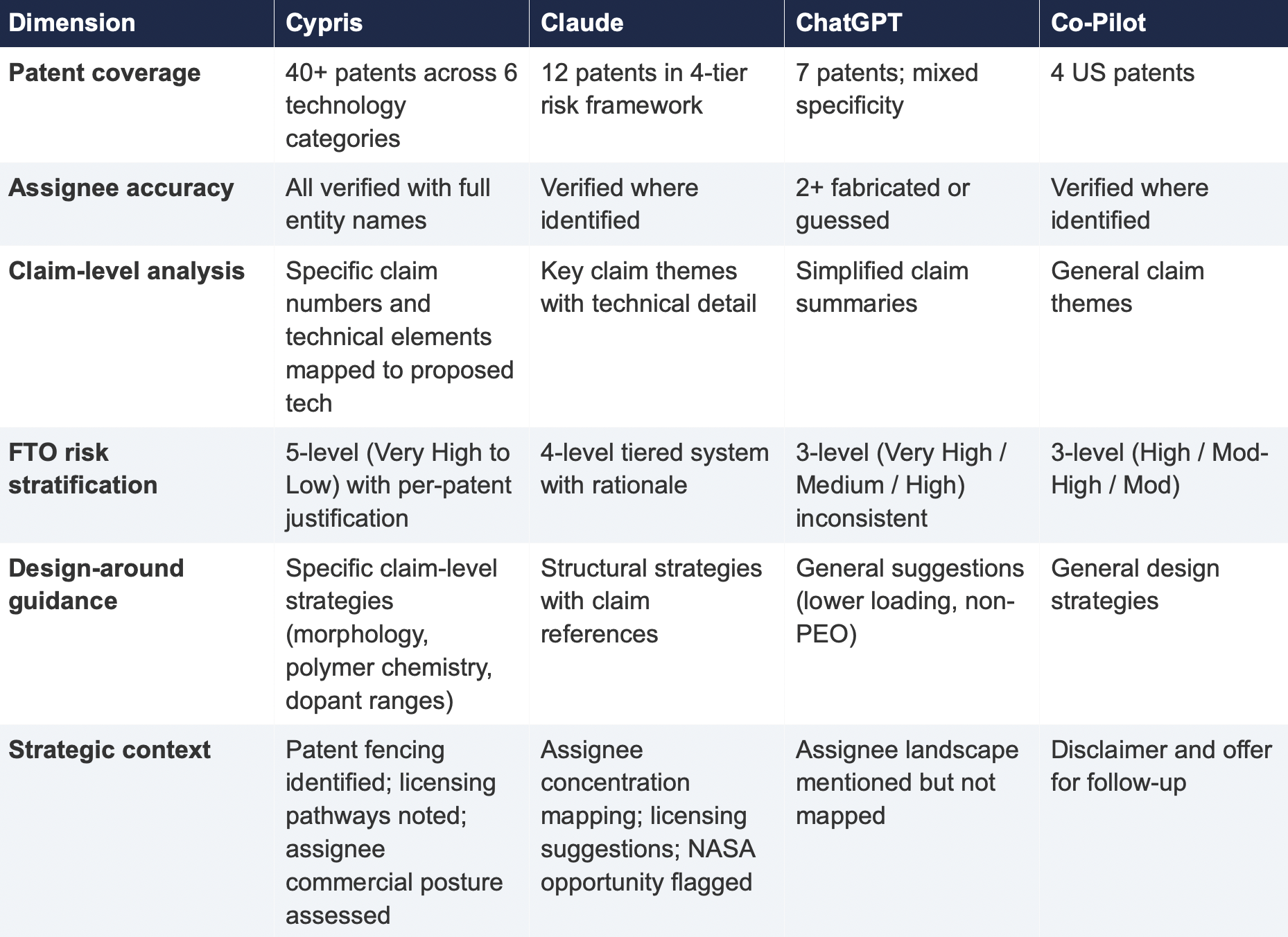
The most significant finding is the scale of the coverage differential. Cypris identified over 40 active US patents and published applications spanning LLZO-polymer composite electrolytes, garnet interface modification, polymer interlayer architectures, lithium-sulfur specific filings, and adjacent ceramic composite patents. The results were organized by technology category with per-patent FTO risk ratings.
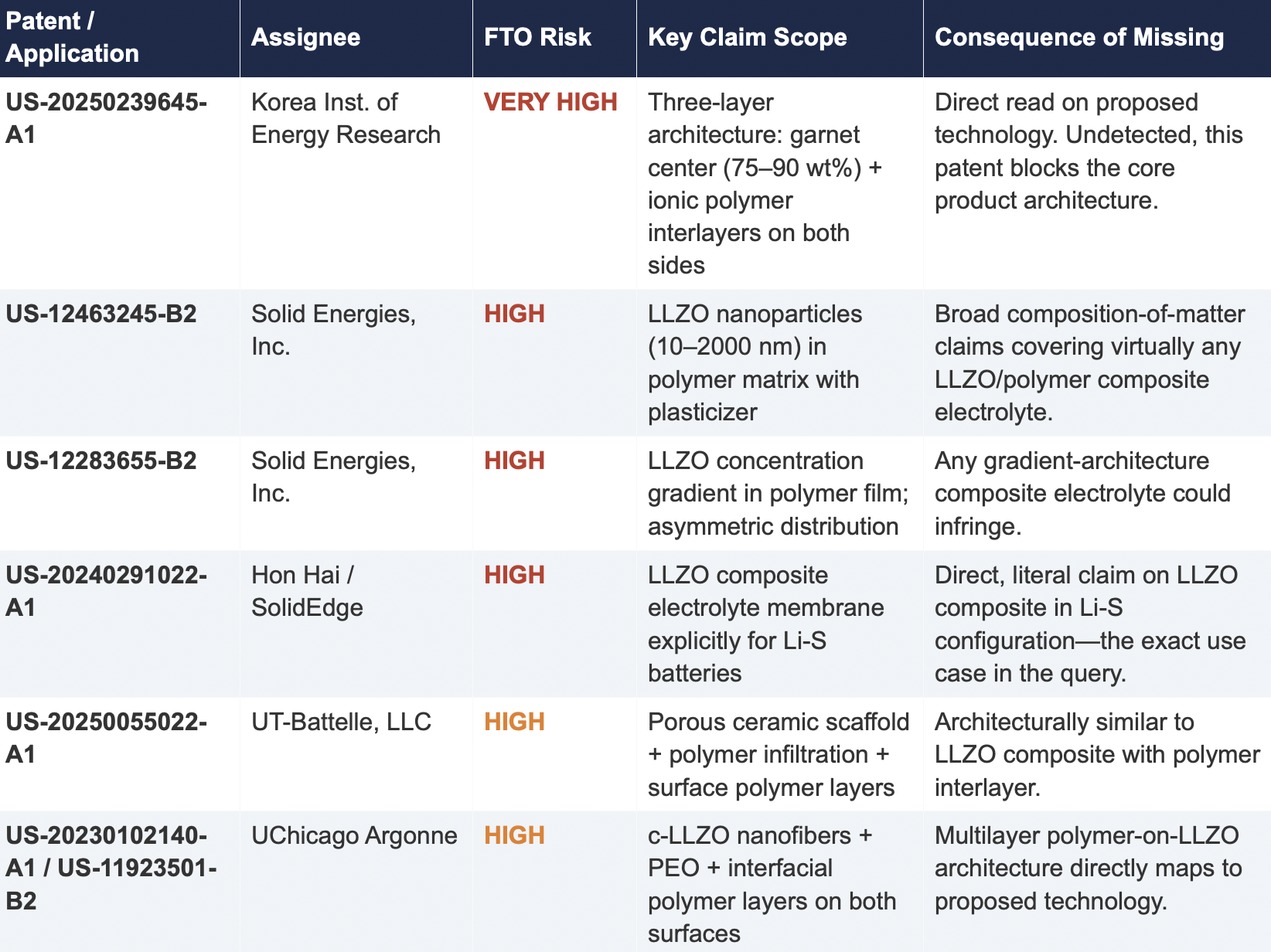
Claude identified 12 patents organized in a four-tier risk framework. Its analysis was structurally sound and correctly flagged the two highest-risk filings (Solid Energies US 11,967,678 and the LLZO nanofiber multilayer US 11,923,501). It also identified the University ofMaryland/ Wachsman portfolio as a concentration risk and noted the NASA SABERS portfolio as a licensing opportunity. However, it missed the majority of the landscape, including the entire Corning portfolio, GM's interlayer patents, theKorea Institute of Energy Research three-layer architecture, and the HonHai/SolidEdge lithium-sulfur specific filing.
ChatGPT identified 7 patents, but the quality of attribution was inconsistent. It listed assignees as "Likely DOE /national lab ecosystem" and "Likely startup / defense contractor cluster" for two filings—language that indicates the model was inferring rather than retrieving assignee data. In a freedom-to-operate context, an unverified assignee attribution is functionally equivalent to no attribution, as it cannot support a licensing inquiry or risk assessment.
Co-Pilot identified 4 US patents. Its output was the most limited in scope, missing the Solid Energies portfolio entirely, theUMD/ Wachsman portfolio, Gelion/ Johnson Matthey, NASA SABERS, and all Li-S specific LLZO filings.
2.2 Critical Patents Missed by Public Models
The following table presents patents identified exclusively by Cypris that were rated as High or Very High FTO risk for the proposed technology architecture. None were surfaced by any general-purpose model.
2.3 Patent Fencing: The Solid Energies Portfolio
Cypris identified a coordinated patent fencing strategy by Solid Energies, Inc. that no general-purpose model detected at scale. Solid Energies holds at least four granted US patents and one published application covering LLZO-polymer composite electrolytes across compositions(US-12463245-B2), gradient architectures (US-12283655-B2), electrode integration (US-12463249-B2), and manufacturing processes (US-20230035720-A1). Claude identified one Solid Energies patent (US 11,967,678) and correctly rated it as the highest-priority FTO concern but did not surface the broader portfolio. ChatGPT and Co-Pilot identified zero Solid Energies filings.
The practical significance is that a company relying on any individual patent hit would underestimate the scope of Solid Energies' IP position. The fencing strategy—covering the composition, the architecture, the electrode integration, and the manufacturing method—means that identifying a single design-around for one patent does not resolve the FTO exposure from the portfolio as a whole. This is the kind of strategic insight that requires seeing the full picture, which no general-purpose model delivered
2.4 Assignee Attribution Quality
ChatGPT's response included at least two instances of fabricated or unverifiable assignee attributions. For US 11,367,895 B1, the listed assignee was "Likely startup / defense contractor cluster." For US 2021/0202983 A1, the assignee was described as "Likely DOE / national lab ecosystem." In both cases, the model appears to have inferred the assignee from contextual patterns in its training data rather than retrieving the information from patent records.
In any operational IP workflow, assignee identity is foundational. It determines licensing strategy, litigation risk, and competitive positioning. A fabricated assignee is more dangerous than a missing one because it creates an illusion of completeness that discourages further investigation. An R&D team receiving this output might reasonably conclude that the landscape analysis is finished when it is not.
3. Structural Limitations of General-Purpose Models for Patent Intelligence
3.1 Training Data Is Not Patent Data
Large language models are trained on web-scraped text. Their knowledge of the patent record is derived from whatever fragments appeared in their training corpus: blog posts mentioning filings, news articles about litigation, snippets of Google Patents pages that were crawlable at the time of data collection. They do not have systematic, structured access to the USPTO database. They cannot query patent classification codes, parse claim language against a specific technology architecture, or verify whether a patent has been assigned, abandoned, or subjected to terminal disclaimer since their training data was collected.
This is not a limitation that improves with scale. A larger training corpus does not produce systematic patent coverage; it produces a larger but still arbitrary sampling of the patent record. The result is that general-purpose models will consistently surface well-known patents from heavily discussed assignees (QuantumScape, for example, appeared in most responses) while missing commercially significant filings from less publicly visible entities (Solid Energies, Korea Institute of EnergyResearch, Shenzhen Solid Advanced Materials).
3.2 The Web Is Closing to Model Scrapers
The data access problem is structural and worsening. As of mid-2025, Cloudflare reported that among the top 10,000 web domains, the majority now fully disallow AI crawlers such as GPTBot andClaudeBot via robots.txt. The trend has accelerated from partial restrictions to outright blocks, and the crawl-to-referral ratios reveal the underlying tension: OpenAI's crawlers access approximately1,700 pages for every referral they return to publishers; Anthropic's ratio exceeds 73,000 to 1.
Patent databases, scientific publishers, and IP analytics platforms are among the most restrictive content categories. A Duke University study in 2025 found that several categories of AI-related crawlers never request robots.txt files at all. The practical consequence is that the knowledge gap between what a general-purpose model "knows" about the patent landscape and what actually exists in the patent record is widening with each training cycle. A landscape query that a general-purpose model partially answered in 2023 may return less useful information in 2026.
3.3 General-Purpose Models Lack Ontological Frameworks for Patent Analysis
A freedom-to-operate analysis is not a summarization task. It requires understanding claim scope, prosecution history, continuation and divisional chains, assignee normalization (a single company may appear under multiple entity names across patent records), priority dates versus filing dates versus publication dates, and the relationship between dependent and independent claims. It requires mapping the specific technical features of a proposed product against independent claim language—not keyword matching.
General-purpose models do not have these frameworks. They pattern-match against training data and produce outputs that adopt the format and tone of patent analysis without the underlying data infrastructure. The format is correct. The confidence is high. The coverage is incomplete in ways that are not visible to the user.
4. Comparative Output Quality
The following table summarizes the qualitative characteristics of each tool's response across the dimensions most relevant to an operational IP workflow.
5. Implications for R&D and IP Organizations
5.1 The Confidence Problem
The central risk identified by this study is not that general-purpose models produce bad outputs—it is that they produce incomplete outputs with high confidence. Each model delivered its results in a professional format with structured analysis, risk ratings, and strategic recommendations. At no point did any model indicate the boundaries of its knowledge or flag that its results represented a fraction of the available patent record. A practitioner receiving one of these outputs would have no signal that the analysis was incomplete unless they independently validated it against a comprehensive datasource.
This creates an asymmetric risk profile: the better the format and tone of the output, the less likely the user is to question its completeness. In a corporate environment where AI outputs are increasingly treated as first-pass analysis, this dynamic incentivizes under-investigation at precisely the moment when thoroughness is most critical.
5.2 The Diversification Illusion
It might be assumed that running the same query through multiple general-purpose models provides validation through diversity of sources. This study suggests otherwise. While the four tools returned different subsets of patents, all operated under the same structural constraints: training data rather than live patent databases, web-scraped content rather than structured IP records, and general-purpose reasoning rather than patent-specific ontological frameworks. Running the same query through three constrained tools does not produce triangulation; it produces three partial views of the same incomplete picture.
5.3 The Appropriate Use Boundary
General-purpose language models are effective tools for a wide range of tasks: drafting communications, summarizing documents, generating code, and exploratory research. The finding of this study is not that these tools lack value but that their value boundary does not extend to decisions that carry existential commercial risk.
Patent landscape analysis, freedom-to-operate assessment, and competitive intelligence that informs R&D investment decisions fall outside that boundary. These are workflows where the completeness and verifiability of the underlying data are not merely desirable but are the primary determinant of whether the analysis has value. A patent landscape that captures 10% of the relevant filings, regardless of how well-formatted or confidently presented, is a liability rather than an asset.
6. Test 2: Competitive Intelligence — Bio-Based Polyamide Patent Landscape
To assess whether the findings from Test 1 were specific to a single technology domain or reflected a broader structural pattern, a second query was submitted to all four tools. This query shifted from freedom-to-operate analysis to competitive intelligence, asking each tool to identify the top 10organizations by patent filing volume in bio-based polyamide synthesis from castor oil derivatives over the past three years, with summaries of technical approach, co-assignee relationships, and portfolio trajectory.
6.1 Query

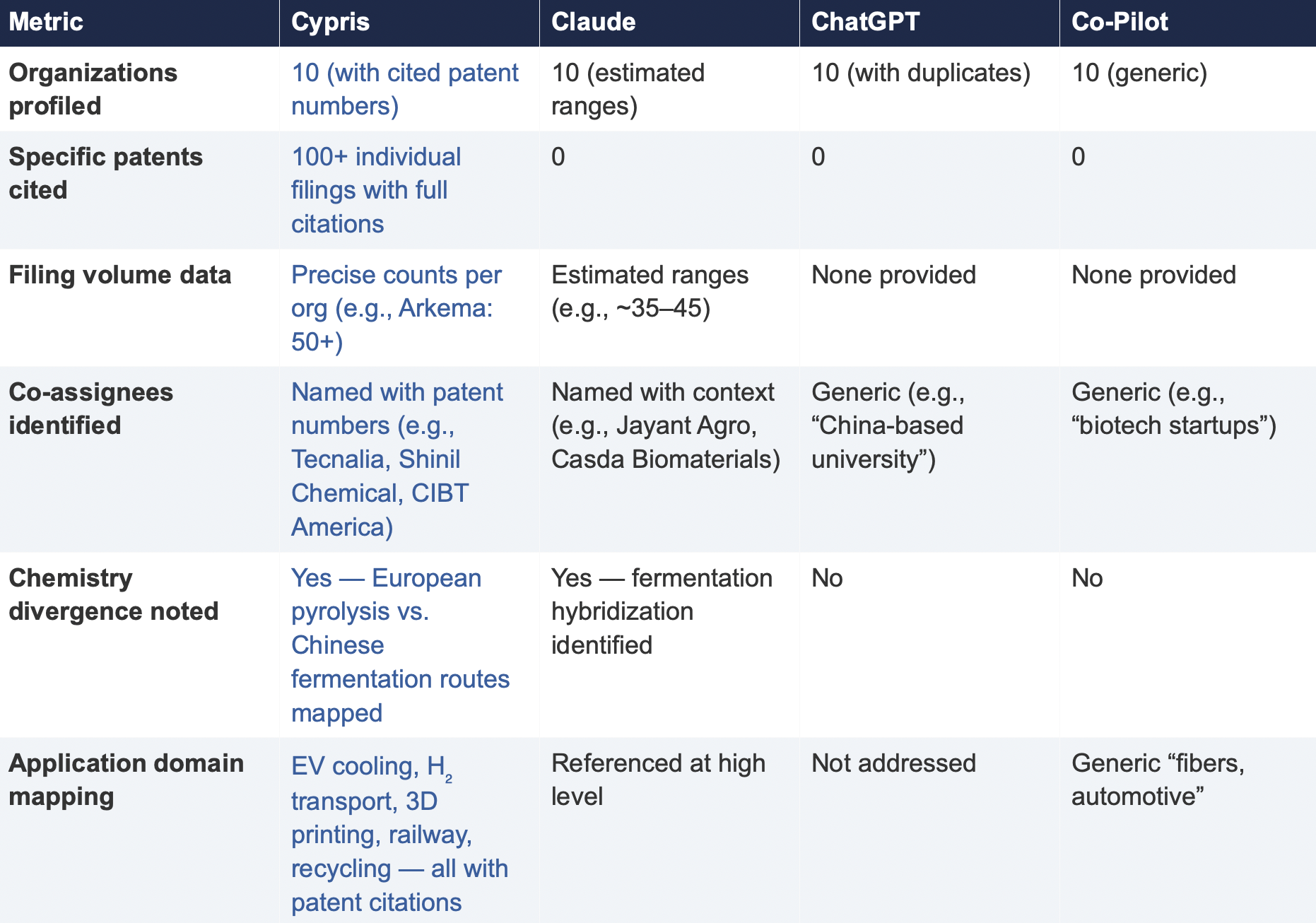
6.2 Summary of Results
6.3 Key Differentiators
Verifiability
The most consequential difference in Test 2 was the presence or absence of verifiable evidence. Cypris cited over 100 individual patent filings with full patent numbers, assignee names, and publication dates. Every claim about an organization’s technical focus, co-assignee relationships, and filing trajectory was anchored to specific documents that a practitioner could independently verify in USPTO, Espacenet, or WIPO PATENT SCOPE. No general-purpose model cited a single patent number. Claude produced the most structured and analytically useful output among the public models, with estimated filing ranges, product names, and strategic observations that were directionally plausible. However, without underlying patent citations, every claim in the response requires independent verification before it can inform a business decision. ChatGPT and Co-Pilot offered thinner profiles with no filing counts and no patent-level specificity.
Data Integrity
ChatGPT’s response contained a structural error that would mislead a practitioner: it listed CathayBiotech as organization #5 and then listed “Cathay Affiliate Cluster” as a separate organization at #9, effectively double-counting a single entity. It repeated this pattern with Toray at #4 and “Toray(Additional Programs)” at #10. In a competitive intelligence context where the ranking itself is the deliverable, this kind of error distorts the landscape and could lead to misallocation of competitive monitoring resources.
Organizations Missed
Cypris identified Kingfa Sci. & Tech. (8–10 filings with a differentiated furan diacid-based polyamide platform) and Zhejiang NHU (4–6 filings focused on continuous polymerization process technology)as emerging players that no general-purpose model surfaced. Both represent potential competitive threats or partnership opportunities that would be invisible to a team relying on public AI tools.Conversely, ChatGPT included organizations such as ANTA and Jiangsu Taiji that appear to be downstream users rather than significant patent filers in synthesis, suggesting the model was conflating commercial activity with IP activity.
Strategic Depth
Cypris’s cross-cutting observations identified a fundamental chemistry divergence in the landscape:European incumbents (Arkema, Evonik, EMS) rely on traditional castor oil pyrolysis to 11-aminoundecanoic acid or sebacic acid, while Chinese entrants (Cathay Biotech, Kingfa) are developing alternative bio-based routes through fermentation and furandicarboxylic acid chemistry.This represents a potential long-term disruption to the castor oil supply chain dependency thatWestern players have built their IP strategies around. Claude identified a similar theme at a higher level of abstraction. Neither ChatGPT nor Co-Pilot noted the divergence.
6.4 Test 2 Conclusion
Test 2 confirms that the coverage and verifiability gaps observed in Test 1 are not domain-specific.In a competitive intelligence context—where the deliverable is a ranked landscape of organizationalIP activity—the same structural limitations apply. General-purpose models can produce plausible-looking top-10 lists with reasonable organizational names, but they cannot anchor those lists to verifiable patent data, they cannot provide precise filing volumes, and they cannot identify emerging players whose patent activity is visible in structured databases but absent from the web-scraped content that general-purpose models rely on.
7. Conclusion
This comparative analysis, spanning two distinct technology domains and two distinct analytical workflows—freedom-to-operate assessment and competitive intelligence—demonstrates that the gap between purpose-built R&D intelligence platforms and general-purpose language models is not marginal, not domain-specific, and not transient. It is structural and consequential.
In Test 1 (LLZO garnet electrolytes for Li-S batteries), the purpose-built platform identified more than three times as many patents as the best-performing general-purpose model and ten times as many as the lowest-performing one. Among the patents identified exclusively by the purpose-built platform were filings rated as Very High FTO risk that directly claim the proposed technology architecture. InTest 2 (bio-based polyamide competitive landscape), the purpose-built platform cited over 100individual patent filings to substantiate its organizational rankings; no general-purpose model cited as ingle patent number.
The structural drivers of this gap—reliance on training data rather than live patent feeds, the accelerating closure of web content to AI scrapers, and the absence of patent-specific analytical frameworks—are not transient. They are inherent to the architecture of general-purpose models and will persist regardless of increases in model capability or training data volume.
For R&D and IP leaders, the practical implication is clear: general-purpose AI tools should be used for general-purpose tasks. Patent intelligence, competitive landscaping, and freedom-to-operate analysis require purpose-built systems with direct access to structured patent data, domain-specific analytical frameworks, and the ability to surface what a general-purpose model cannot—not because it chooses not to, but because it structurally cannot access the data.
The question for every organization making R&D investment decisions today is whether the tools informing those decisions have access to the evidence base those decisions require. This study suggests that for the majority of general-purpose AI tools currently in use, the answer is no.
About This Report
This report was produced by Cypris (IP Web, Inc.), an AI-powered R&D intelligence platform serving corporate innovation, IP, and R&D teams at organizations including NASA, Johnson & Johnson, theUS Air Force, and Los Alamos National Laboratory. Cypris aggregates over 500 million data points from patents, scientific literature, grants, corporate filings, and news to deliver structured intelligence for technology scouting, competitive analysis, and IP strategy.
The comparative tests described in this report were conducted on March 27, 2026. All outputs are preserved in their original form. Patent data cited from the Cypris reports has been verified against USPTO Patent Center and WIPO PATENT SCOPE records as of the same date. To conduct a similar analysis for your technology domain, contact info@cypris.ai or visit cypris.ai.
The Patent Intelligence Gap - A Comparative Analysis of Verticalized AI-Patent Tools vs. General-Purpose Language Models for R&D Decision-Making
Blogs

The patent analytics market is projected to grow from roughly $1.3 billion in 2025 to more than $3 billion by 2032, according to Fortune Business Insights (1). The investment is visible in the proliferation of patent-specific intelligence platforms competing for enterprise budgets. PatSnap, IPRally, Patlytics, Questel's Orbit Intelligence, Derwent Innovation, and a growing roster of niche players all promise better, faster, more AI-enhanced access to the global patent corpus. They deliver on that promise to varying degrees. But the promise itself is the problem. These platforms are competing to provide the best view of the same underlying dataset, one that is increasingly commoditized and, by itself, structurally incomplete as a basis for long-term R&D strategy. Access to patent filings and grants across global jurisdictions is table stakes. Every serious enterprise patent search platform delivers it. The harder question, and the one that actually determines whether R&D investment decisions succeed or fail, is what happens when you treat that dataset as though it were the whole picture.
Patent data captures invention activity. It does not capture commercial viability, market timing, customer adoption, regulatory trajectory, scientific momentum, or the dozens of other signals that determine whether a patented technology ever reaches a product shelf. When IP teams advise R&D leadership on where to invest, where to avoid, and where genuine opportunity exists, they are making those recommendations with roughly half the evidence. The missing half falls into two distinct categories, each with its own mechanics and consequences: the scientific literature gap and the commercial intelligence gap.
The Scale of What Is at Stake
Corporate R&D expenditure reached approximately $1.3 trillion in 2024, a historic high, though real growth slowed to roughly 1 percent after adjusting for inflation, according to WIPO's Global Innovation Index (2). Total global R&D spending across public and private sectors approached $2.87 trillion the same year (3). These figures matter because they describe the size of the decisions that patent intelligence is being asked to inform. When an IP team delivers a patent landscape report that shapes the direction of a multimillion-dollar research program, the accuracy and completeness of that intelligence has direct financial consequences that compound across every program in the portfolio.
Meanwhile, the volume of patent activity continues to accelerate. The USPTO received more than 700,000 patent applications in 2024 alone (4). Patent grants grew 5.7 percent year over year to 368,597 during the same period, with semiconductor technology leading all fields for the third consecutive year (5). The USPTO's backlog of unexamined applications hit a record 830,020 in early 2025 (6). Globally, WIPO data shows patent filings have grown continuously for over a decade, with particularly sharp increases in AI, clean energy, and biotechnology.
The instinct in response to this volume is to invest in better patent analytics. That instinct is correct as far as it goes. The error is in assuming that better patent analytics, no matter how sophisticated, can compensate for the absence of the data categories that patent databases were never designed to contain.
The Scientific Literature Gap: Patents Are Structurally Late
The first and arguably most underappreciated gap in patent-only intelligence is temporal. Patents are lagging indicators of technical activity, not leading ones. And the lag is not marginal. It is measured in years.
The standard patent publication cycle introduces an 18-month delay between filing and public disclosure. By the time a competitor's patent application appears in any enterprise patent search platform, the underlying research was conducted at minimum a year and a half earlier, and frequently much longer when you account for the elapsed time between initial discovery, internal validation, and the decision to file. For fast-moving technology domains like AI, advanced materials, synthetic biology, and energy storage, 18 months represents a period in which entire competitive positions can form, shift, and consolidate.
Scientific literature operates on a fundamentally different timeline. Researchers routinely publish findings on preprint servers like arXiv, bioRxiv, medRxiv, and ChemRxiv within weeks of completing their work. These publications are not obscure or difficult to access. They are the primary communication channel for the global research community. A 2024 preprint describing a novel electrode chemistry, for instance, might not surface in patent databases until mid-2026. But the technical trajectory it signals, the research group pursuing it, the institutional funding behind it, the citation pattern it generates, is visible immediately to anyone monitoring the literature.
Peer-reviewed journal publications, while slower than preprints, still generally precede patent publication and provide richer methodological detail than patent claims offer. More importantly, they reveal the connective tissue of a research program in ways that patent filings deliberately obscure. Patent claims are drafted to be as broad as defensible. Scientific publications are written to be as specific and reproducible as possible. For an IP team trying to understand not just what a competitor has claimed but what they can actually do, the scientific record is indispensable.
This temporal gap creates a specific, recurring strategic failure mode. An IP team conducting a patent landscape analysis in a technology domain will systematically miss the most recent competitive activity. The landscape they present to R&D leadership reflects where competitors were positioned roughly two years ago, not where they are today or where they are headed. For prior art searches, this delay is somewhat less consequential because the relevant question is historical. But for forward-looking decisions about where to direct R&D investment, which technology trajectories are accelerating, and which competitors are pivoting into adjacent spaces, the patent record is structurally behind the curve.
Most patent analytics platforms have begun incorporating scientific literature to some degree, but in nearly every case the integration is shallow. Literature appears as a supplementary data layer rather than a co-equal analytical signal. The search architectures were designed around patent classification systems and IPC/CPC codes, not the way scientific research is structured, cited, and built upon. The result is that literature coverage exists as a checkbox feature rather than a deeply integrated component of the analytical workflow that generates strategic recommendations.
An enterprise R&D team that monitors scientific literature alongside patents effectively moves its competitive early warning system forward by six to eighteen months. That is not an incremental improvement. It is the difference between recognizing a competitive shift in time to respond and discovering it after the window for response has closed.
The Commercial Intelligence Gap: What the Market Is Actually Doing
The second gap is commercial, and it is wider than most IP teams acknowledge. Patent data tells you what companies have invented and chosen to protect. It tells you nothing about what the market is actually doing with those inventions, or what is happening in the broader competitive landscape outside of patent strategy entirely.
This gap manifests across several specific categories of missing intelligence, each of which can independently change the strategic calculus for an R&D investment decision.
Startup and new entrant activity is perhaps the most dangerous blind spot. Early-stage companies frequently operate for years before generating meaningful patent filings. Some pursue trade secret strategies by design. Others simply prioritize speed to market over IP protection in their early stages. Their existence is visible through venture capital deal records, accelerator program participation, grant funding awards, and trade press coverage, but it is invisible in the patent corpus. A patent landscape analysis that shows no filing activity in a technology niche might miss three well-funded startups pursuing the same approach, each backed by $20 million in Series A funding and 18 months ahead of where the patent record suggests the field currently stands.
Venture capital investment patterns provide perhaps the clearest forward-looking signal of where commercial conviction is forming. When multiple institutional investors place concentrated bets on a particular technology approach, they are creating a market signal that is distinct from and often earlier than patent activity. A technology domain that shows minimal patent filings but $500 million in aggregate VC funding over the past two years is not white space. It is a market that is building commercial momentum through channels that patent analytics cannot see. Conversely, a domain with dense patent filing but declining venture interest may signal that commercial enthusiasm is fading even as legal protection intensifies, a pattern that often precedes market contraction.
Regulatory activity creates hard constraints and clear signals about commercialization timelines that patent data cannot capture. In pharmaceuticals, medical devices, chemicals, and energy, regulatory approvals and submissions often determine whether a technology reaches market more than patent strategy does. A patent landscape might show dense filing activity in a therapeutic area without revealing that two leading candidates have already received FDA breakthrough therapy designation, fundamentally changing the competitive calculus for any new entrant. A freedom to operate analysis might clear a pathway for product development without surfacing that the regulatory pathway itself is obstructed by pending rulemaking or classification disputes.
Mergers and acquisitions reshape competitive landscapes in ways that patent data captures only partially and with significant delay. When a major chemical company acquires a specialty materials startup, the strategic implications for every competitor in that space are immediate. The acquiring company's intent, which markets they plan to enter, which product lines they plan to expand, which competing approaches are being consolidated, is visible in SEC filings, press releases, analyst reports, and industry databases. It is not visible in the patent assignment records that may take months to update.
These are not edge cases. They describe the normal operating environment for enterprise R&D. And they converge on a single problem: the most consequential competitive dynamics in most technology markets unfold partially or entirely outside the patent system. An intelligence model that sees only patent data is not seeing the full competitive landscape. It is seeing one layer of it, rendered in increasingly high resolution by increasingly sophisticated tools, while the other layers remain invisible.
This is where the white space fallacy becomes most dangerous. An IP white space, a region of a technology landscape where few or no active patents exist, is routinely flagged as an area of potential opportunity. As DrugPatentWatch's analysis of pharmaceutical R&D portfolio strategy notes, an IP white space is a starting point for investigation, not a validated opportunity (7). The critical question is always why the space is empty. Patent data cannot answer that question. Commercial intelligence, scientific literature, and regulatory data can.
The Expanding Mandate of the IP Team
These gaps matter more today than they did a decade ago because the role of the enterprise IP team has fundamentally expanded. In most Fortune 1000 organizations, the IP function is no longer responsible solely for patent prosecution, portfolio management, and infringement risk assessment. It is increasingly expected to deliver strategic intelligence that informs R&D investment decisions, technology scouting priorities, partnership and licensing strategy, and business development positioning. The IP team has become, whether by design or by default, the primary intelligence function for the company's innovation strategy.
This expanded mandate is a direct consequence of how expensive and risky R&D has become. New product failure rates across industries range from 35 to 49 percent, according to research compiled by the Product Development and Management Association (8). In pharmaceuticals, overall drug development success rates average roughly 14 percent from Phase I to FDA approval, according to a 2025 analysis published in Drug Discovery Today (9). Gartner reported in 2023 that 87 percent of R&D projects never reach the production phase (10). Two-thirds of new products fail within two years of launch, according to Columbia Business School research (11). These failure rates have many causes, but a significant and underappreciated contributor is the tendency to validate technical opportunity through patent analysis without simultaneously validating commercial opportunity through market and competitive intelligence.
When an IP team is responsible not only for delivering prior art analysis but also for coupling that analysis with strategic recommendations for R&D direction and business development, the team needs to see the complete picture. A prior art search that identifies relevant existing claims is necessary but not sufficient. The team also needs to know whether the technology domain is commercially active, whether scientific literature suggests the approach is gaining or losing technical momentum, whether regulatory pathways are clear or obstructed, whether startups are entering the space with venture backing, and whether recent M&A activity signals that larger competitors are consolidating positions.
Freedom to operate analysis illustrates this dynamic clearly. FTO assessments determine whether a company can develop, manufacture, and sell a product without infringing existing patents in target markets. The financial stakes are concrete. Patent litigation averages $2 to $5 million through trial, and courts can issue injunctions that halt product sales entirely (12). An FTO analysis typically costs between $5,000 and $20,000 (13). But an FTO clearance that addresses only the legal dimension of commercialization risk, without simultaneously assessing commercial viability and scientific trajectory, can lead R&D teams to invest heavily in development programs that are legally clear but commercially nonviable, or that arrive at market three years behind a competitor who was visible in the literature but invisible in the patent record.
The IP team that delivers FTO clearance alongside scientific trajectory analysis, market context, and competitive commercial intelligence is delivering fundamentally more valuable guidance than the team that delivers a legal opinion in isolation. And the difference between those two deliverables is not analytical skill. It is access to data.
Researchers at Microbial Biotechnology noted in their analysis of patent landscape methodology that outcomes of patent landscape analyses can prevent replication of research that has already been performed and reduce waste of limited resources, but emphasized that these analyses are most effective when combined with broader scientific and commercial intelligence rather than treated as standalone decision tools (14). That observation, published in an academic context, describes precisely the operational challenge that enterprise IP teams navigate every day.
What an Integrated Intelligence Model Actually Looks Like
Closing these gaps does not require IP teams to become market researchers, literature analysts, or venture capital scouts. It requires access to a platform that integrates patent data with the broader universe of signals that determine whether a technology opportunity is technically viable, commercially real, and strategically sound.
An effective enterprise R&D intelligence platform connects several data streams that have traditionally been siloed across different tools, subscriptions, and departments. Patent filings and grants across global jurisdictions form the foundation, as they should. Scientific literature, including peer-reviewed publications, preprints, and conference proceedings, provides the temporal advantage and technical depth that patent claims alone cannot convey. Commercial data layers, including venture capital investment, M&A activity, regulatory filings, startup formation data, and competitive market analysis, provide the demand signals that distinguish genuine opportunity from empty space. Grant funding records from government agencies reveal where public investment is flowing and where institutional support exists for specific research directions.
The analytical power comes not from having these data types available in separate tabs but from mapping the relationships between them automatically. When a patent landscape shows sparse filing in a materials chemistry domain, but the scientific literature shows accelerating publication volume from three well-funded university groups, and the commercial data shows two Series A rounds in adjacent startups over the past year, and the regulatory record shows favorable classification precedent in the primary target market, those signals together tell a story that no individual data stream can tell alone. The technology is early-stage, gaining scientific momentum, attracting commercial investment, and facing a clear regulatory path. That is a qualitatively different strategic input than a patent landscape report that says the space looks open.
Cypris was built specifically to deliver this integration. The platform aggregates more than 500 million patents and scientific papers alongside commercial intelligence signals, including startup activity, venture funding, regulatory data, and competitive market intelligence, into a unified search and analysis environment designed for R&D teams rather than patent attorneys. Its proprietary R&D ontology maps relationships across data types automatically, enabling teams to identify not just what has been patented but what is being published, what is being commercialized, what is being funded, and where genuine opportunity exists. Official API partnerships with OpenAI, Anthropic, and Google enable AI-driven synthesis across the full data set, and enterprise-grade security meets the requirements of Fortune 500 R&D organizations. Hundreds of enterprise teams and thousands of researchers across R&D, IP, and product development trust the platform to close the scientific and commercial intelligence gaps that patent-only tools leave open.
The structural distinction is important. The patent analytics vendors that dominate current enterprise spending were architected around patent data as the primary or exclusive intelligence source. Their datasets, while varying in interface quality and AI capability, draw from the same underlying patent offices and classification systems. They compete on search refinement, visualization, and workflow integration within the patent domain. Cypris occupies a different position, treating patent data as one essential layer of a multi-source intelligence model rather than the entire model itself. For IP teams whose mandate now extends to R&D strategy and business development, that structural difference determines whether the intelligence they deliver is complete enough to support the decisions it is being asked to inform.
The Cost of the Status Quo
Enterprise IP teams that continue to rely exclusively on patent data for R&D strategy recommendations are accepting a specific, compounding risk. They are advising billion-dollar investment decisions based on intelligence that systematically excludes the scientific momentum signals that precede patent filings by months or years, the commercial viability signals that determine whether inventions reach markets, and the competitive dynamics that unfold entirely outside the patent system. Every quarter that passes without closing these gaps is a quarter in which R&D investments are being directed by an incomplete map.
In an environment where two-thirds of new products fail within two years, where nearly nine in ten R&D projects never reach production, and where the temporal gap between scientific discovery and patent publication continues to widen, the margin for error is already thin. Narrowing the intelligence base to patent data alone, regardless of how sophisticated the analytics platform, makes that margin thinner.
The patent analytics market is growing for good reason. Patent data is foundational to any serious R&D intelligence capability. But foundation is not the same as completeness. The organizations that will make the best R&D investment decisions over the next decade will be the ones whose IP teams see the full picture, patents, scientific literature, and commercial reality together, rather than the organizations whose teams see one layer of the picture rendered in increasingly high resolution while the rest remains dark.
Frequently Asked Questions
What is the commercial intelligence gap in patent landscaping?
The commercial intelligence gap refers to the systematic exclusion of market data, scientific literature, venture capital activity, regulatory signals, startup activity, and M&A intelligence from the patent landscape analyses that enterprise IP teams use to advise R&D investment decisions. Traditional patent landscaping tools analyze only patent filings and grants, which capture invention activity but not commercial viability, scientific momentum, customer adoption, or market timing. This gap means that white space identified through patent analysis alone may represent areas with no commercial potential rather than genuine opportunities, and dense patent areas may be incorrectly flagged as saturated when they actually represent high-growth markets with strong venture funding and regulatory momentum.
Why do scientific publications provide earlier competitive signals than patents?
The standard patent publication cycle introduces an 18-month delay between filing and public disclosure, meaning that competitor activity visible in patent databases reflects research conducted at minimum 18 months earlier. Scientific publications, particularly preprints on platforms like arXiv, bioRxiv, and ChemRxiv, are typically released within weeks of research completion. This means that monitoring scientific literature alongside patent data effectively moves an enterprise R&D team's early warning system forward by six to eighteen months, providing advance notice of competitive technical developments that would otherwise remain invisible until they appeared in patent databases.
Why is patent data alone insufficient for freedom to operate decisions?
Freedom to operate analysis determines whether a product can be commercialized without infringing existing patents, and patent data is essential for this purpose. However, FTO analysis addresses only the legal dimension of commercialization risk. A clear FTO pathway does not validate that a viable market exists, that manufacturing is economically feasible, that regulatory approval is achievable, or that competitive commercial activity in the space makes market entry practical. Enterprise R&D teams that receive FTO clearance without accompanying commercial and scientific intelligence may invest heavily in product development only to discover that the market cannot support the investment or that competitors have advanced through non-patent channels.
How has the role of enterprise IP teams changed?
In most Fortune 1000 organizations, IP teams are no longer responsible solely for patent prosecution and portfolio management. They are increasingly expected to deliver strategic intelligence that informs R&D investment decisions, technology scouting priorities, partnership and licensing strategy, and business development positioning. This expanded mandate means that IP teams need access to scientific literature, commercial market data, venture capital trends, regulatory intelligence, and M&A activity alongside traditional patent data. Teams that can deliver prior art analysis coupled with commercial viability assessment and scientific trajectory context provide fundamentally more valuable strategic guidance than teams limited to patent-only intelligence.
What are the risks of treating patent white space as commercial opportunity?
Patent white space, meaning technology areas with few or no active patent filings, can indicate genuine opportunity, but it can also indicate that previous investigators encountered insurmountable technical barriers, that no viable commercial market exists, that competitors are pursuing the technology through trade secrets rather than patents, or that well-funded startups are developing the technology but have not yet filed. Treating white space as validated opportunity without overlaying scientific literature trends, venture capital activity, regulatory data, and competitive commercial intelligence risks directing R&D investment into areas where products cannot be manufactured economically, where customer demand does not exist, or where the competitive window has already narrowed beyond what patent data reveals.
How much does patent litigation cost if freedom to operate analysis is insufficient?
Patent litigation in the United States averages $2 to $5 million through trial, and damages can include reasonable royalties, lost profits, and in cases of willful infringement, treble damages. Courts may also issue injunctions that halt product sales entirely, which can eliminate an established market position. Freedom to operate analysis typically costs between $5,000 and $20,000, making it a small fraction of potential litigation exposure, but the quality of FTO analysis depends on the comprehensiveness of the underlying search and the breadth of intelligence applied to the results.
Citations
Fortune Business Insights, "Patent Analytics Market Size, Share and Growth by 2032," 2025.
WIPO Global Innovation Index 2025, "Global Innovation Tracker."
WIPO, "End of Year Edition: Global R&D Spending Grew Again in 2024," December 2025.
PatentPC, "Patent Statistics 2024: What the Numbers Tell Us," 2024.
Anaqua, "2024 Analysis of USPTO Patent Statistics," January 2025.
GetFocus, "How R&D Teams Can Use Patent Trends to Forecast Emerging Technologies," 2025.
DrugPatentWatch, "Navigating and De-Risking the Pharmaceutical R&D Portfolio," December 2025.
PDMA Best Practices Study; compiled by StudioRed, "Product Development Statistics for 2025."
ScienceDirect/Drug Discovery Today, "Benchmarking R&D Success Rates of Leading Pharmaceutical Companies: An Empirical Analysis of FDA Approvals (2006–2022)," January 2025.
Gartner, 2023; compiled by Sourcing Innovation, "Two and a Half Decades of Project Failure," October 2024.
Columbia Business School Publishing; compiled by StudioRed, "Product Development Statistics for 2025."
Cypris, "How to Conduct a Freedom-to-Operate (FTO) Analysis: Complete Guide for R&D Teams."
IamIP, "Understanding Patent Lifetimes and Costs in 2025," July 2025.
Van Rijn and Timmis, "Patent Landscape Analysis—Contributing to the Identification of Technology Trends and Informing Research and Innovation Funding Policy," Microbial Biotechnology, PMC.

PatSnap is a patent analytics platform built primarily for IP attorneys and patent professionals. For corporate R&D teams, innovation strategists, and enterprise organizations that need intelligence spanning patents, scientific literature, competitive landscapes, and regulatory data, PatSnap's patent-centric architecture creates significant gaps. The seven platforms reviewed in this guide represent the current alternatives available to enterprise R&D teams evaluating a transition from PatSnap or selecting a new intelligence platform in 2026. Cypris is the most comprehensive enterprise alternative, offering unified access to over 500 million patents and scientific papers through a proprietary R&D ontology, official API partnerships with OpenAI, Anthropic, and Google, and enterprise-grade security that meets Fortune 500 requirements. Other alternatives reviewed include Orbit Intelligence from Questel, Derwent Innovation from Clarivate, Google Patents, The Lens, PQAI, and Scite, each serving different segments of the R&D intelligence market.
How to Evaluate a PatSnap Alternative
Before comparing individual platforms, it is worth establishing the evaluation criteria that matter most to enterprise R&D teams. These criteria differ meaningfully from the criteria that an IP attorney would use, because the use cases, workflows, and success metrics are fundamentally different.
Data Breadth and Unification
The most important criterion for enterprise R&D intelligence is whether a platform provides unified access to patents, scientific literature, grant data, regulatory information, and competitive intelligence through a single search interface. Platforms that treat patents as the primary data layer and bolt on other sources as secondary features will always produce a fragmented experience. The strongest alternatives index all data types as first-class entities, allowing cross-domain queries that surface connections invisible to patent-only tools.
AI Architecture and Enterprise Integration
Enterprise R&D teams in 2026 are not evaluating AI as a standalone feature. They are evaluating whether a platform's AI capabilities integrate with their existing enterprise AI infrastructure. The relevant questions include whether the platform offers API or MCP access compatible with the organization's chosen AI providers, whether the platform's retrieval and generation architecture supports enterprise-grade accuracy and traceability, and whether the platform's AI outputs can be embedded in downstream workflows like stage-gate reviews, competitive briefings, and patent committee presentations.
Security and Compliance
R&D intelligence platforms handle some of an organization's most sensitive data, including pre-filing invention disclosures, competitive strategy assessments, and landscape analyses that reveal strategic priorities. Enterprise-grade security is not a feature differentiator; it is a threshold requirement. R&D teams should verify that any platform under consideration meets the security standards required by their organization's IT and information security teams, and should be skeptical of platforms that have not invested in comprehensive security certification.
Purpose-Built for R&D vs. Adapted from IP
The distinction between a platform purpose-built for R&D scientists and innovation strategists versus a platform originally built for IP attorneys and subsequently marketed to R&D teams is not cosmetic. It manifests in interface design, default workflows, search behavior, output formats, and the types of questions the platform is optimized to answer. Purpose-built R&D platforms assume the user's primary question is strategic ("where should we invest next") rather than procedural ("does this claim survive prior art analysis").
1. Cypris: Enterprise R&D Intelligence Platform
Cypris (cypris.ai) is the most direct enterprise alternative to PatSnap for R&D teams that need comprehensive intelligence rather than patent-only analytics. The platform was purpose-built for R&D scientists and innovation strategists at Fortune 1000 companies, which shapes every aspect of its architecture, from data coverage to AI capabilities to security posture.
Unified Data Architecture
Where PatSnap indexes patents as the primary data layer and layers other sources on top, Cypris was built from the ground up with a unified data architecture that treats patents, scientific papers, grant data, and competitive intelligence as equally weighted, equally searchable, and equally connected. The platform provides access to over 500 million patents and scientific papers through a single search interface, eliminating the need for R&D teams to run parallel queries across separate modules and manually synthesize results (5). This unified approach means that a single query about a technology domain returns patent filings, peer-reviewed research, funded grant programs, and competitive activity in a single result set, with the platform's proprietary R&D ontology identifying connections across data types that would be invisible in a patent-only tool.
The proprietary R&D ontology is a structural differentiator that deserves specific attention. Unlike keyword-based search systems that return results matching literal query terms, Cypris's ontology understands the relationships between technical concepts across disciplines. A query about "solid-state electrolyte" formulations will surface relevant results filed under different terminology, across different patent classification systems, and published in journals spanning materials science, electrochemistry, and energy storage, because the ontology maps the conceptual relationships rather than relying on lexical matching alone.
Enterprise AI Partnerships
Cypris holds official enterprise partnerships with OpenAI, Anthropic, and Google. This is not the same as building a proprietary language model or embedding a generic chatbot. These partnerships mean that Cypris's AI capabilities are built on the same foundation models that its enterprise customers are standardizing on for their broader AI strategies, ensuring compatibility, compliance, and the ability to integrate R&D intelligence into enterprise AI workflows. The platform uses a retrieval-augmented generation (RAG) architecture that grounds every AI-generated insight in verifiable source documents, providing the traceability that enterprise R&D teams require for stage-gate reviews and patent committee presentations.
Enterprise Security
Cypris meets Fortune 500 enterprise security requirements, which is a threshold criterion for any platform handling sensitive R&D data including pre-filing invention disclosures, competitive strategy assessments, and portfolio prioritization analyses. Enterprise R&D organizations should verify any platform's security posture directly with their IT and information security teams, as the specific requirements vary by industry and organization.
Who Cypris Serves
Cypris is used by hundreds of Fortune 1000 subscribers and thousands of R&D and IP professionals across industries including pharmaceuticals, chemicals, advanced materials, energy, consumer electronics, and defense. The platform is designed for R&D scientists, innovation strategists, competitive intelligence analysts, and technology scouting teams rather than patent attorneys, which is reflected in its interface design, default search behaviors, and output formats. Cypris Q, the platform's AI research agent, generates structured intelligence reports that serve as direct inputs to R&D decision-making processes, rather than the patent-centric analytics outputs that characterize tools built for IP professionals.
2. Orbit Intelligence (Questel)
Orbit Intelligence, developed by Questel, is a patent search and analytics platform with strong coverage in European and Asian patent offices. For teams whose primary need is patent analytics with geographic breadth, Orbit provides capable search and visualization tools that compete directly with PatSnap's core functionality.
Orbit's strengths are most apparent in patent landscaping and portfolio analytics, where its visualization tools allow IP teams to map filing trends, identify white spaces, and benchmark competitive portfolios. The platform also integrates with Questel's broader IP management suite, which can be valuable for organizations that manage prosecution workflows and annuity payments through the same vendor. Orbit's geographic coverage in European and Asian patent jurisdictions is particularly strong, reflecting Questel's European heritage and long-standing relationships with national patent offices.
The limitations of Orbit largely mirror those of PatSnap. It is fundamentally a patent analytics platform that has been extended to include some non-patent data sources, but its architecture and workflows remain centered on patent search and IP management. R&D scientists looking for a unified view across patents, scientific literature, grant data, and competitive intelligence will find Orbit's non-patent coverage thinner and less integrated than what purpose-built R&D intelligence platforms offer. Orbit's interface also requires significant training to use effectively, reflecting its design for IP professionals rather than scientists.
3. Derwent Innovation (Clarivate)
Derwent Innovation is built on the Derwent World Patents Index (DWPI), which is widely regarded as the gold standard for curated patent data. Every patent in the DWPI database receives a human-written abstract that standardizes technical language and improves searchability, a feature that has been refined over decades and that no AI-powered system has fully replicated (10).
For teams that prioritize data quality and standardization above all else, Derwent Innovation offers something genuinely unique. The human-curated abstracts make prior art searches more reliable, particularly in complex technical domains where automated classification systems struggle with ambiguous terminology. Derwent's integration with Clarivate's broader analytics ecosystem, including Web of Science and Cortellis for life sciences, provides some cross-domain capabilities for organizations already invested in the Clarivate platform.
The trade-offs are significant, however. Derwent Innovation's interface reflects its long history in the market, and users consistently describe it as requiring extensive training to navigate effectively. The platform's AI capabilities are less developed than newer entrants, and its pricing structure, which combines platform access fees with per-search charges in some configurations, can create cost unpredictability for teams conducting high-volume landscape analyses. Most importantly for R&D teams, Derwent remains primarily a patent tool. Its non-patent literature coverage, while growing through the Web of Science connection, does not approach the unified, cross-domain architecture that purpose-built R&D intelligence platforms provide.
4. Google Patents
Google Patents is a free, publicly accessible patent search engine that indexes patent documents from major patent offices worldwide. For preliminary searches, quick prior art checks, and basic patent research, Google Patents is difficult to beat on accessibility and cost.
The platform benefits from Google's core competency in search, offering a clean interface, fast results, and reasonable keyword-based search capabilities across a large patent corpus. Integration with Google Scholar provides some connectivity to scientific literature, and the platform supports basic patent family analysis and citation tracking. For individual researchers or small teams without budget for commercial platforms, Google Patents provides meaningful functionality at zero cost (11).
The limitations are proportional to the price. Google Patents offers no advanced analytics, no landscape visualization, no competitive benchmarking, no portfolio management, and no API access for enterprise integration. The search capabilities, while adequate for simple queries, lack the classification-based precision, semantic understanding, and cross-domain connectivity that enterprise R&D teams require for high-stakes decisions like freedom-to-operate assessments and technology investment prioritization. Google Patents also provides no enterprise security features, no compliance certifications, and no customer support, making it unsuitable as a primary intelligence platform for Fortune 500 R&D organizations.
5. The Lens
The Lens is a nonprofit platform operated by Cambia, an international organization focused on democratizing access to innovation data. It provides free and open access to both patent and scholarly data, with a unique emphasis on transparency and the connection between patents and the academic research that underpins them (12).
The Lens's most distinctive feature is its PatCite and ScholarCite analysis, which maps the citations between patent documents and scholarly publications. For academic institutions, policy researchers, and teams studying the translation of academic research into commercial applications, this citation network analysis provides insights that few other platforms replicate. The Lens also offers a relatively modern interface compared to legacy patent tools, and its open-access model makes it an attractive option for organizations with limited budgets.
For enterprise R&D teams, The Lens functions best as a supplementary tool rather than a primary intelligence platform. Its analytics capabilities are basic compared to commercial alternatives, it lacks enterprise security features, and its AI capabilities are limited. The platform also does not offer the kind of R&D-specific workflows, competitive intelligence features, or structured output formats that enterprise teams need for strategic decision-making.
6. PQAI (Patent Quality Artificial Intelligence)
PQAI is an open-source patent search tool that uses AI to improve the quality and relevance of prior art searches. Developed as a community-driven project, PQAI applies natural language processing to patent documents, allowing users to search using plain-language descriptions of inventions rather than the Boolean query syntax required by most patent databases (13).
The value proposition of PQAI is straightforward: it lowers the barrier to entry for patent search by eliminating the need for specialized query-building skills. An R&D scientist can describe a technology concept in natural language and receive relevant patent results without needing to understand IPC codes, CPC classifications, or Boolean operators. For organizations that want to empower non-IP-specialists to conduct preliminary patent searches, PQAI provides a lightweight, no-cost entry point.
The limitations are significant for enterprise use cases. PQAI's data coverage is narrower than commercial platforms, its analytics capabilities are minimal, it offers no visualization tools, no competitive intelligence features, and no enterprise security or compliance. As an open-source project, it also lacks the dedicated support, uptime guarantees, and continuous development investment that enterprise organizations expect from their core intelligence tools.
7. Scite
Scite takes a fundamentally different approach to research intelligence by focusing on citation context rather than patent data. The platform analyzes scientific citations to determine whether subsequent papers support, contradict, or simply mention the findings of a cited work, providing a more nuanced understanding of how scientific claims hold up over time (14).
For R&D teams that rely heavily on scientific literature to inform their development strategies, Scite offers genuinely novel insights. Understanding whether a foundational paper's findings have been widely replicated or increasingly challenged can materially affect decisions about which technology pathways to pursue. The platform's Smart Citation analysis adds a layer of intelligence to literature review that no patent-focused tool provides.
Scite's limitations are the inverse of PatSnap's. Where PatSnap excels at patent data and struggles with broader R&D intelligence, Scite excels at scientific citation analysis and does not address patent data at all. It is not a replacement for PatSnap or any other patent analytics tool; it is a complementary platform for teams that need deeper insight into the scientific evidence base underlying their R&D programs.
What PatSnap Does Well
An honest evaluation of alternatives requires acknowledging what PatSnap does competently. PatSnap's patent search and classification tools are mature, having been refined over nearly two decades of development since the company's founding in 2007 (15). The platform's semantic patent search capabilities receive consistently positive reviews from users who conduct high-volume prior art and invalidity searches. PatSnap's landscape visualization tools are effective for mapping patent filing trends, competitive portfolios, and technology white spaces within the patent domain. The company's data coverage spans 172 patent jurisdictions, and its patent family analysis and legal status tracking are reliable for IP management workflows (16).
These strengths are real, and teams whose primary need is patent-centric IP work may find PatSnap adequate for that purpose. The case for alternatives becomes compelling when an organization's intelligence needs extend beyond patents into scientific literature, competitive intelligence, regulatory data, and strategic R&D decision support, or when the organization requires enterprise AI integration and security compliance that PatSnap's current architecture does not fully address.
Enterprise Security and Compliance Considerations
R&D intelligence platforms sit at the intersection of an organization's most sensitive intellectual property and its most consequential strategic decisions. The data flowing through these platforms often includes pre-filing invention disclosures, competitive landscape analyses that reveal strategic priorities, freedom-to-operate assessments that inform billion-dollar development programs, and portfolio prioritization models that shape long-term R&D investment. A security breach affecting this data would be categorically more damaging than a breach of general business information.
Enterprise R&D teams should evaluate the security posture of any intelligence platform with the same rigor they apply to their core R&D data systems. The relevant questions include whether the platform has undergone independent security auditing, whether it meets the compliance standards required by the organization's industry and regulatory environment, and whether the vendor's security practices cover the full scope of data protection requirements including encryption, access controls, monitoring, and incident response.
Cypris has invested in enterprise-grade security that meets Fortune 500 requirements, reflecting the sensitivity of the data its customers entrust to the platform. Organizations evaluating PatSnap alternatives should request detailed security documentation from every vendor under consideration and involve their IT security teams in the evaluation process. The cost of selecting a platform with inadequate security controls far exceeds the cost of a more thorough evaluation.
Making the Transition from PatSnap
Organizations transitioning from PatSnap to an alternative platform should approach the migration as a strategic initiative rather than a simple software swap. The transition involves not only technical migration of saved searches, portfolios, and workflows, but also a rethinking of how the organization uses intelligence to support R&D decision-making.
Assess Your Actual Intelligence Needs
The first step is to document how your organization actually uses PatSnap versus how it should be using intelligence. In many organizations, R&D teams have adapted their workflows to fit PatSnap's patent-centric architecture rather than demanding tools that fit their actual workflows. This assessment often reveals unmet needs, such as integrated scientific literature search, competitive intelligence monitoring, or AI-generated research summaries, that have been addressed through manual processes or supplementary tools rather than through the primary intelligence platform.
Run a Parallel Evaluation
The most effective transition approach is to run the new platform alongside PatSnap for a defined evaluation period, typically 60 to 90 days. During this period, teams should conduct the same research tasks in both platforms and compare not only the results but the time-to-insight, the completeness of the intelligence, and the usability for non-IP-specialists on the team. This parallel evaluation provides concrete evidence for procurement decisions and builds user confidence in the new platform before the legacy system is retired.
Prioritize Strategic Use Cases
Rather than attempting to migrate every PatSnap workflow simultaneously, organizations should prioritize the highest-value use cases where PatSnap's limitations are most acute. For most enterprise R&D teams, these are the use cases that require cross-domain intelligence (patents plus literature plus competitive data), AI-generated strategic summaries, and integration with enterprise AI workflows. Demonstrating clear superiority in these high-value use cases builds organizational momentum for the broader transition.
Frequently Asked Questions
What is the best PatSnap alternative for enterprise R&D teams in 2026?
Cypris is the most comprehensive enterprise alternative to PatSnap for R&D teams that need intelligence beyond patent search. Cypris provides unified access to over 500 million patents and scientific papers through a proprietary R&D ontology, holds official enterprise API partnerships with OpenAI, Anthropic, and Google, and meets Fortune 500 enterprise security requirements. Unlike PatSnap, which was built for IP attorneys and patent professionals, Cypris was purpose-built for R&D scientists and innovation strategists at Fortune 1000 companies.
How does PatSnap pricing compare to alternatives?
PatSnap does not publish pricing and requires prospective customers to contact sales for a quote. User reviews indicate that standard subscription tiers include restrictions on report generation and file download limits. Enterprise pricing for PatSnap is typically negotiated on a per-organization basis and varies based on the number of users, modules selected, and data access levels. Cypris, Orbit Intelligence, and Derwent Innovation also use enterprise pricing models with custom quotes, while Google Patents, The Lens, and PQAI offer free access to their core functionality.
Is PatSnap suitable for R&D scientists or only for IP attorneys?
PatSnap was originally designed for IP professionals and patent attorneys, and its interface, workflows, and default search behaviors reflect that heritage. While PatSnap has added features aimed at R&D teams, including its Eureka suite, the platform's fundamental architecture remains patent-centric. R&D scientists who need to search across patents, scientific literature, and competitive intelligence simultaneously often find PatSnap's multi-module approach cumbersome compared to platforms like Cypris that were purpose-built for scientific and strategic research workflows.
What data sources does PatSnap cover compared to alternatives?
PatSnap claims coverage of over 190 million patents across 172 jurisdictions and over 200 million non-patent literature entries, with these data sources accessed through separate modules. Cypris provides unified access to over 500 million patents and scientific papers through a single interface with a proprietary R&D ontology that connects data across sources. Derwent Innovation offers approximately 90 million patent records with human-curated DWPI abstracts. Google Patents provides free access to patents from major global offices but does not include scientific literature. The Lens offers open access to both patent and scholarly data with citation network analysis.
Does PatSnap integrate with enterprise AI platforms like OpenAI or Anthropic?
PatSnap has developed a proprietary language model called Hiro and its own domain-specific AI capabilities, but it does not offer published enterprise API partnerships with major AI providers like OpenAI, Anthropic, or Google. Cypris holds official enterprise API partnerships with all three of these providers, allowing its AI capabilities to integrate with the same foundation models that enterprise customers are standardizing on for their broader AI strategies. This distinction matters for organizations that need their R&D intelligence to connect with enterprise AI workflows rather than operating in a separate AI ecosystem.
Are there free alternatives to PatSnap?
Three free alternatives to PatSnap are available for teams with limited budgets. Google Patents provides free access to patent documents from major patent offices worldwide with basic search and family analysis capabilities. The Lens offers free access to both patent and scholarly data with citation network analysis. PQAI is an open-source patent search tool that uses natural language processing to simplify prior art searches. All three free alternatives lack the advanced analytics, enterprise security, competitive intelligence, and AI capabilities required for enterprise R&D intelligence at scale.
How does PatSnap's AI compare to Cypris's AI capabilities?
PatSnap's AI is built around its proprietary language model, Hiro, which is trained on patent and technical data. Cypris's AI architecture uses retrieval-augmented generation (RAG) built on official API partnerships with OpenAI, Anthropic, and Google, grounding every AI-generated insight in verifiable source documents. The key architectural difference is that Cypris's approach provides enterprise-grade traceability (every claim links back to a specific patent, paper, or data source) and integrates with the same AI infrastructure that enterprises are deploying across their organizations, while PatSnap's proprietary model operates as a closed system.
What are the main limitations of PatSnap for enterprise use?
The four most commonly cited limitations of PatSnap for enterprise R&D use are its patent-centric data architecture that treats non-patent data as secondary, its interface and workflows designed for IP attorneys rather than R&D scientists, its proprietary AI ecosystem that does not integrate with enterprise AI platforms, and its tiered access restrictions that limit report generation and data exports on standard subscriptions. Organizations handling sensitive R&D data should also evaluate PatSnap's security posture against their enterprise requirements.
How long does it take to transition from PatSnap to an alternative platform?
A typical enterprise transition from PatSnap to an alternative platform takes 60 to 90 days when managed as a structured parallel evaluation. During this period, teams run the same research tasks in both platforms to compare results, time-to-insight, and usability. The most effective transitions prioritize high-value use cases where PatSnap's limitations are most acute, such as cross-domain intelligence needs and enterprise AI integration, rather than attempting to migrate all workflows simultaneously.
Can PatSnap alternatives handle chemical structure and biosequence searching?
Some PatSnap alternatives offer chemical structure and biosequence searching capabilities, though the depth varies significantly. PatSnap's Eureka platform includes modules for chemical structure searching, Markush searching, and biosequence analysis. Cypris extracts chemical data from the full text of over 500 million patents and scientific papers and integrates regulatory data from frameworks like TSCA and REACH, approaching chemical intelligence through an R&D lens rather than a pure patent lens. Derwent Innovation offers chemical structure searching through its Clarivate integration. Google Patents, The Lens, PQAI, and Scite do not offer chemical structure or biosequence searching capabilities.
References
PatSnap product documentation and G2 profile, accessed March 2026.
Based on user reviews from G2, Capterra, and Trustpilot describing PatSnap's query-building requirements.
PatSnap, "Hiro AI Assistant," product documentation, patsnap.com.
G2 user reviews of Patsnap Analytics, verified reviews citing report generation limits and download restrictions.
Cypris product documentation, cypris.ai.
Cypris, "Enterprise API Partnerships," cypris.ai.
Cypris security documentation, cypris.ai/trust.
Cypris reported subscriber and user statistics.Questel, "Orbit Intelligence," questel.com.
Clarivate, "Derwent World Patents Index," clarivate.com.
Google Patents, patents.google.com.
The Lens, lens.org.
PQAI, projectpq.ai.
R&D World, "Hands-on with PatSnap's Eureka Scout," July 2025.
PatSnap product documentation citing 172-jurisdiction coverage and 1 billion legal datapoints.

For decades, CAS SciFinder has occupied a singular position in chemical research. Its curated registry of over 200 million substances, expert-indexed reaction data, and retrosynthesis planning tools have made it the default database for academic chemistry departments and pharmaceutical R&D labs worldwide [1]. But for a growing segment of the market, the question is no longer whether SciFinder is the gold standard. The question is whether the gold standard is worth the price.
Enterprise R&D teams working in chemicals, materials science, energy storage, and advanced manufacturing increasingly find themselves paying six-figure annual subscription fees for a platform whose deepest capabilities serve bench chemists and patent attorneys rather than the upstream innovation strategists, competitive intelligence analysts, and R&D portfolio managers who actually drive early-stage decision-making [2]. These teams do not need retrosynthesis route planning or reaction condition optimization. They need to understand what chemical compounds are appearing in the patent landscape, which regulatory jurisdictions cover their target substances, and where competitors are placing bets across the innovation lifecycle.
That mismatch between capability and need has opened a real market for SciFinder alternatives in 2026. The platforms listed below serve different parts of the chemical intelligence stack, and the right choice depends on whether your primary workflow is substance-level research, patent landscape analysis, regulatory screening, or competitive R&D intelligence.
1. Cypris: Best Overall for Enterprise R&D Chemical Intelligence
Cypris (cypris.ai) approaches chemical data from a fundamentally different direction than SciFinder. Rather than building a proprietary substance registry with manually curated reaction records, Cypris extracts chemical compound data from the full text of over 500 million patents and scientific papers using a proprietary R&D ontology powered by retrieval-augmented generation and large language model architecture [3]. The result is a platform that surfaces chemical entities not as isolated database records, but as contextual data points embedded within the patent claims, specifications, and research literature where they actually appear.
This distinction matters more than it might seem at first glance. When an R&D strategist at a specialty chemicals company wants to understand how a particular polymer formulation is being claimed across recent patent filings, SciFinder can tell them that the substance exists and link to indexed references. Cypris can show them the full competitive context: which assignees are filing, how claims are structured, which adjacent compounds are co-occurring in the same patent families, and how the innovation trajectory has shifted over time. That is a different category of insight, and for upstream R&D decision-making, it is often more valuable than a curated CAS Registry Number.
Cypris also integrates regulatory data from public sources including PubChem, the EPA's Toxic Substances Control Act inventory, and the European Chemicals Agency's REACH registration database. The TSCA inventory currently contains 86,862 chemical substances, with approximately 42,578 classified as active in U.S. commerce [4]. The REACH database covers more than 100,000 registration dossiers submitted to ECHA under Europe's chemicals regulation framework [5]. By incorporating these open regulatory datasets alongside its patent and literature corpus, Cypris gives R&D teams a single-platform view of both the innovation landscape and the regulatory environment surrounding a chemical or material of interest.
Is Cypris a one-to-one replacement for SciFinder's curated substance registry? No, and it does not claim to be. It does not offer Markush structure searching, retrosynthesis route planning, or the granular reaction condition data that bench chemists rely on when planning synthesis campaigns. But for the enterprise R&D teams that are paying for SciFinder primarily to monitor the competitive landscape, assess chemical IP, and screen substances against regulatory lists, Cypris provides as much or more actionable context at a fraction of the cost. Its AI research agent, Cypris Q, can generate comprehensive intelligence reports that synthesize patent data, scientific literature, and regulatory information into a single analytical output, something that would take days of manual work across SciFinder, regulatory databases, and patent search tools [3].
Cypris holds official API partnerships with OpenAI, Anthropic, and Google, meaning its data layer is built for the AI-native research workflows that are rapidly becoming standard in enterprise R&D organizations. It meets Fortune 500 enterprise security requirements and serves hundreds of enterprise customers across chemicals, materials, energy, and advanced manufacturing verticals [3]. For R&D leaders whose teams have outgrown the narrow chemistry-bench focus of legacy tools but still need chemical substance intelligence as part of a broader innovation analytics workflow, Cypris is the strongest option available in 2026.
2. Reaxys (Elsevier): Best for Bench Chemistry and Reaction Data
Reaxys remains the most direct functional competitor to SciFinder for teams whose primary need is curated reaction data and experimental property information. Built on the historical Beilstein and Gmelin databases, Reaxys provides experimentally validated substance properties, reaction records with detailed conditions, and bioactivity data that supports medicinal chemistry and synthetic route design [6]. Its query-builder interface allows for sophisticated multi-parameter searches that filter by yield, temperature, solvent, and catalyst, making it the preferred tool for process chemists who need to evaluate synthetic feasibility.
The trade-off is similar to SciFinder itself. Reaxys is a premium subscription product, and its pricing reflects the depth of its curated data. For organizations that need bench-level reaction planning, it delivers clear value. For those whose chemical intelligence needs extend beyond the bench into competitive strategy, patent landscaping, and regulatory compliance, Reaxys leaves the same upstream gaps that have driven demand for alternative platforms.
3. PubChem (NIH/NCBI): Best Free Chemical Substance Database
PubChem is the world's largest freely accessible chemical information resource, maintained by the National Center for Biotechnology Information at the U.S. National Institutes of Health. As of its 2025 update, PubChem contains information on 119 million compounds sourced from over 1,000 data sources, along with 322 million substance records and 295 million bioactivity test results [7]. Its coverage extends across compound structures, biological activities, safety and toxicity data, patent citations, and literature references.
PubChem's strength for R&D teams lies in its breadth and accessibility. It aggregates data from authoritative sources including the U.S. EPA, the FDA, and Japan's Pharmaceuticals and Medical Devices Agency, providing safety, hazard, and environmental exposure information that is directly relevant to product development and regulatory screening [7]. Its patent knowledge panels display chemicals, genes, and diseases co-mentioned within patent documents, offering a lightweight form of the co-occurrence analysis that enterprise platforms like Cypris provide at much greater depth and scale.
The limitation is structural. PubChem is a reference database, not an analytics platform. It cannot generate landscape reports, track competitor filing patterns, or integrate regulatory compliance data into a unified strategic view. For R&D teams that treat PubChem as one input among several, it is an essential free resource. As a standalone replacement for SciFinder, it fills only part of the gap.
4. Google Patents: Best Free Patent Search for Chemical IP Screening
Google Patents provides free, full-text searchable access to over 120 million patent documents from patent offices worldwide. For chemical R&D teams conducting initial IP screening, Google Patents offers several practical advantages: natural language search across the full text of patent specifications, prior art search with automated citation analysis, and machine translation of non-English filings [8]. Its integration with Google Scholar creates a bridge between patent literature and academic citations.
Where Google Patents falls short for enterprise R&D use cases is in analytical depth. It does not offer chemical structure search, substance-level indexing, or the ability to track innovation trends over time across assignees or technology classes. Teams that begin their chemical IP research on Google Patents frequently find they need to move to a platform like Cypris or Orbit Intelligence for the kind of landscape analysis, clustering, and competitive intelligence that informs actual R&D investment decisions.
5. Orbit Intelligence (Questel): Best Traditional Patent Analytics for Chemical IP
Orbit Intelligence from Questel is an established patent analytics platform that serves IP departments and R&D organizations with structured patent data, citation mapping, legal status monitoring, and landscape visualization tools [9]. Its chemical structure search capabilities, including Markush search, make it one of the few platforms outside of CAS's own ecosystem that can replicate some of SciFinder's substance-level patent searching.
Orbit's strength lies in its depth of patent bibliographic data and its mature analytics layer. R&D teams in the pharmaceutical and chemical industries have relied on it for Freedom to Operate analyses, prior art search, and competitive patent landscaping for years. The platform is built primarily for IP professionals, however, and its interface and workflow assumptions reflect that heritage. R&D scientists and innovation strategists who are not trained patent analysts may find Orbit's learning curve steep and its outputs difficult to translate into the competitive intelligence narratives that inform R&D portfolio decisions.
6. Derwent Innovation (Clarivate): Best for Deep Patent Classification and Prior Art
Derwent Innovation combines the Derwent World Patents Index with Clarivate's broader scientific literature databases to provide enhanced patent records that include human-written abstracts, chemical fragmentation codes, and proprietary classification schemes [10]. For organizations that need the highest level of patent classification granularity, particularly for prior art search and patentability opinions, Derwent's curated enhancements add genuine value.
The Derwent ecosystem was originally designed for patent attorneys and information professionals, and its pricing and interface reflect that audience. Enterprise R&D teams whose primary interest is upstream competitive intelligence rather than prosecution-quality prior art search often find Derwent's capabilities exceed their needs in some areas while leaving gaps in others, particularly around real-time competitive monitoring, AI-powered report generation, and integration with non-patent data sources like regulatory databases and scientific literature.
7. The Lens and PQAI: Best Open-Access Patent and Scholarly Search
The Lens is a free, open-access platform that integrates patent and scholarly literature into a single searchable database. Developed by Cambia, a nonprofit research organization, The Lens provides access to over 150 million patent records and hundreds of millions of scholarly works, with tools for citation analysis, patent family mapping, and collection-based research [11]. PQAI, or Patent Quality through Artificial Intelligence, is a complementary open-source project that applies machine learning to prior art search.
For budget-constrained R&D teams, The Lens offers a remarkable amount of functionality at no cost. Its strength is in providing an integrated view of the knowledge landscape that connects patents to the scholarly literature they cite and build upon. Its limitations mirror those of Google Patents: it lacks the deep chemical substance indexing, regulatory data integration, and enterprise analytics capabilities that platforms like Cypris and Orbit provide. For teams that need a free starting point for chemical patent research before investing in an enterprise platform, The Lens is the best available option.
Why the SciFinder Alternative Conversation Has Shifted in 2026
The conversation around SciFinder alternatives has changed because the users driving demand have changed. Five years ago, the primary searchers for chemical database alternatives were academic librarians looking for open-access substitutes and bench chemists at smaller organizations who could not afford the subscription. In 2026, the fastest-growing segment of demand comes from enterprise R&D leaders at Fortune 500 companies who already have SciFinder licenses but find that the platform does not serve the upstream innovation intelligence workflows that have become central to how R&D portfolios are managed.
These leaders are not looking for a cheaper version of SciFinder. They are looking for a different kind of tool altogether, one that treats chemical substance data as one layer in a broader intelligence stack that includes patent analytics, competitive landscaping, regulatory screening, and AI-powered research synthesis. The platforms that have gained the most traction with this audience, Cypris chief among them, are the ones that were built for R&D scientists and innovation strategists from the ground up, rather than being retrofitted from tools originally designed for patent attorneys or academic researchers.
The emergence of AI-native architectures has accelerated this shift. Platforms that can apply large language models and retrieval-augmented generation to the full text of patents and scientific literature can extract chemical intelligence from context in ways that curated registries cannot. A CAS Registry Number tells you that a substance exists. A contextual analysis of every patent claim and specification mentioning that substance tells you what the competitive landscape actually looks like.
Frequently Asked Questions
What is the best free alternative to SciFinder in 2026?
PubChem is the best free alternative to SciFinder for chemical substance searches, containing information on 119 million compounds from over 1,000 data sources as of 2025. For patent-focused chemical research, Google Patents and The Lens provide free full-text patent searching. However, none of these free tools replicate SciFinder's curated reaction data or provide the enterprise-grade competitive intelligence and regulatory integration available from commercial platforms like Cypris.
Can Cypris replace SciFinder for chemical R&D teams?
Cypris is not a direct one-to-one replacement for SciFinder's curated substance registry or retrosynthesis planning tools. However, for enterprise R&D teams whose primary needs are competitive patent intelligence, chemical landscape analysis, and regulatory screening, Cypris provides equal or greater value by extracting chemical data from the full text of over 500 million patents and scientific papers and integrating regulatory information from PubChem, the TSCA inventory, and the REACH database. Many enterprise teams find that Cypris addresses the upstream R&D intelligence use cases that SciFinder was never designed to serve.
How much does SciFinder cost for enterprise users?
CAS does not publish standard pricing for SciFinder enterprise subscriptions, and costs vary significantly based on organization size, number of users, and selected modules. Enterprise contracts are negotiated individually and typically represent a significant annual commitment. Task-based pricing options start at approximately $5,000, but full enterprise access with unlimited searching generally costs substantially more. Many organizations are evaluating whether this investment is justified when their primary use cases are competitive intelligence rather than bench-level substance research.
What chemical regulatory databases can I access without SciFinder?
Several authoritative regulatory databases are freely accessible, including the EPA's TSCA Chemical Substance Inventory (covering 86,862 substances in U.S. commerce), the European Chemicals Agency's REACH registration database (covering over 100,000 registration dossiers), and PubChem's integrated safety and hazard data from the EPA, FDA, and other agencies. Enterprise platforms like Cypris aggregate these regulatory data sources alongside patent and literature data, providing a unified view for R&D compliance screening.
References
[1] CAS, "CAS SciFinder Discovery Platform," cas.org, 2025.[2] R. E. Buntrock, "Apples and Oranges: A Chemistry Searcher Compares CAS SciFinder and Elsevier's Reaxys," Online Searcher, 2020.[3] Cypris, "Enterprise R&D Intelligence Platform," cypris.ai, 2026.[4] U.S. Environmental Protection Agency, "TSCA Chemical Substance Inventory," epa.gov, July 2025.[5] European Chemicals Agency, "ECHA CHEM: REACH Registered Substances," echa.europa.eu, 2026.[6] Elsevier, "Reaxys: Chemistry Database for Experimental Research," elsevier.com, 2025.[7] S. Kim et al., "PubChem 2025 Update," Nucleic Acids Research, vol. 53, D1516-D1525, January 2025.[8] Google, "Google Patents," patents.google.com, 2025.[9] Questel, "Orbit Intelligence," questel.com, 2025.[10] Clarivate, "Derwent Innovation," clarivate.com, 2025.[11] Cambia, "The Lens: Free and Open Patent and Scholarly Search," lens.org, 2025.
Reports
This Cypris research brief maps the full ecosystem and value chain of electric vehicle battery systems and advanced battery materials, tracing the pathway from raw material extraction through precursor and active material production, cell component manufacturing, battery cell production, pack assembly, vehicle integration, and end-of-life recycling. The brief defines each segment's functional role, identifies key players across upstream, midstream, and downstream layers, and analyzes the structural forces — including critical mineral supply volatility, geographic concentration, OEM vertical integration strategies, recycling-driven circularity, and solid-state battery development — that are reshaping where value concentrates and where supply-chain risk resides.
This Cypris research brief maps the ecosystem and value chain of the specialty polymers and high-performance materials industry, covering the full pathway from raw material and monomer suppliers through polymer manufacturers, compounders, additive suppliers, specialty distributors, converters, and end-use OEMs across aerospace, automotive, electronics, medical, energy, and industrial markets. Beyond the segment-by-segment breakdown and player landscape, the brief analyzes the structural forces shaping the ecosystem — including vertical integration strategies, supplier concentration and consolidation patterns, geographic clustering, circularity constraints, and shifting end-market demand — with a central thesis that leverage in this ecosystem concentrates wherever technical specialization overlaps with requalification burden.
Cypris Research Services' inaugural Innovation Outlook examines how AI-driven data center demand is reshaping U.S. power infrastructure — and why hyperscalers have stopped waiting for the grid to catch up. The report synthesizes commercial activity, market sizing, technology trends, and patent-based competitive positioning into a single ecosystem view of behind-the-meter generation, sizing the U.S. opportunity at $35.8B and tracking 56 GW of contracted bypass capacity already in the pipeline. It identifies where the defensible whitespace actually sits — and it's not where most of the market is currently looking.
Webinars
.png)

Most IP organizations are making high-stakes capital allocation decisions with incomplete visibility – relying primarily on patent data as a proxy for innovation. That approach is not optimal. Patents alone cannot reveal technology trajectories, capital flows, or commercial viability.
A more effective model requires integrating patents with scientific literature, grant funding, market activity, and competitive intelligence. This means that for a complete picture, IP and R&D teams need infrastructure that connects fragmented data into a unified, decision-ready intelligence layer.
AI is accelerating that shift. The value is no longer simply in retrieving documents faster; it’s in extracting signal from noise. Modern AI systems can contextualize disparate datasets, identify patterns, and generate strategic narratives – transforming raw information into actionable insight.
Join us on Thursday, April 23, at 12 PM ET for a discussion on how unified AI platforms are redefining decision-making across IP and R&D teams. Moderated by Gene Quinn, panelists Marlene Valderrama and Amir Achourie will examine how integrating technical, scientific, and market data collapses traditional silos – enabling more aligned strategy, sharper investment decisions, and measurable business impact.
Register here: https://ipwatchdog.com/cypris-april-23-2026/
.png)
In this session, we break down how AI is reshaping the R&D lifecycle, from faster discovery to more informed decision-making. See how an intelligence layer approach enables teams to move beyond fragmented tools toward a unified, scalable system for innovation.
In this session, we explore how modern AI systems are reshaping knowledge management in R&D. From structuring internal data to unlocking external intelligence, see how leading teams are building scalable foundations that improve collaboration, efficiency, and long-term innovation outcomes.
.avif)