

Resources
Guides, research, and perspectives on R&D intelligence, IP strategy, and the future of AI enabled innovation.

Executive Summary
In 2024, US patent infringement jury verdicts totaled $4.19 billion across 72 cases. Twelve individual verdicts exceeded $100million. The largest single award—$857 million in General Access Solutions v.Cellco Partnership (Verizon)—exceeded the annual R&D budget of many mid-market technology companies. In the first half of 2025 alone, total damages reached an additional $1.91 billion.
The consequences of incomplete patent intelligence are not abstract. In what has become one of the most instructive IP disputes in recent history, Masimo’s pulse oximetry patents triggered a US import ban on certain Apple Watch models, forcing Apple to disable its blood oxygen feature across an entire product line, halt domestic sales of affected models, invest in a hardware redesign, and ultimately face a $634 million jury verdict in November 2025. Apple—a company with one of the most sophisticated intellectual property organizations on earth—spent years in litigation over technology it might have designed around during development.
For organizations with fewer resources than Apple, the risk calculus is starker. A mid-size materials company, a university spinout, or a defense contractor developing next-generation battery technology cannot absorb a nine-figure verdict or a multi-year injunction. For these organizations, the patent landscape analysis conducted during the development phase is the primary risk mitigation mechanism. The quality of that analysis is not a matter of convenience. It is a matter of survival.
And yet, a growing number of R&D and IP teams are conducting that analysis using general-purpose AI tools—ChatGPT, Claude, Microsoft Co-Pilot—that were never designed for patent intelligence and are structurally incapable of delivering it.
This report presents the findings of a controlled comparison study in which identical patent landscape queries were submitted to four AI-powered tools: Cypris (a purpose-built R&D intelligence platform),ChatGPT (OpenAI), Claude (Anthropic), and Microsoft Co-Pilot. Two technology domains were tested: solid-state lithium-sulfur battery electrolytes using garnet-type LLZO ceramic materials (freedom-to-operate analysis), and bio-based polyamide synthesis from castor oil derivatives (competitive intelligence).
The results reveal a significant and structurally persistent gap. In Test 1, Cypris identified over 40 active US patents and published applications with granular FTO risk assessments. Claude identified 12. ChatGPT identified 7, several with fabricated attribution. Co-Pilot identified 4. Among the patents surfaced exclusively by Cypris were filings rated as “Very High” FTO risk that directly claim the technology architecture described in the query. In Test 2, Cypris cited over 100 individual patent filings with full attribution to substantiate its competitive landscape rankings. No general-purpose model cited a single patent number.
The most active sectors for patent enforcement—semiconductors, AI, biopharma, and advanced materials—are the same sectors where R&D teams are most likely to adopt AI tools for intelligence workflows. The findings of this report have direct implications for any organization using general-purpose AI to inform patent strategy, competitive intelligence, or R&D investment decisions.

1. Methodology
A controlled comparative evaluation was conducted on March 27, 2026. An identical patent landscape query was submitted verbatim to each platform under standardized testing conditions. No follow-up prompts, clarifications, or iterative refinements were permitted, ensuring that each platform was evaluated based solely on its initial response.
The outputs were preserved in their original form and evaluated against predefined criteria using publicly verifiable patent records.
1.1 Query
Identify all active US patents and published applications filed in the last 5 years related to solid-state lithium-sulfur battery electrolytes using garnet-type ceramic materials. For each, provide the assignee, filing date, key claims, and current legal status. Highlight any patents that could pose freedom-to-operate risks for a company developing a Li₇La₃Zr₂O₁₂(LLZO)-based composite electrolyte with a polymer interlayer.
1.2 Tools Evaluated

1.3 Evaluation Criteria
Each response was evaluated using a consistent six-part scoring framework: patent coverage, assignee accuracy, filing metadata completeness, depth of claim analysis, quality of FTO risk stratification, and the presence of actionable strategic guidance.
Patent numbers, assignees, filing information, and legal status were independently checked against publicly available USPTO and WIPO records. The evaluation focused on the completeness, accuracy, and practical utility of each platform’s output rather than writing quality or presentation.
2. Findings
2.1 Coverage Gap
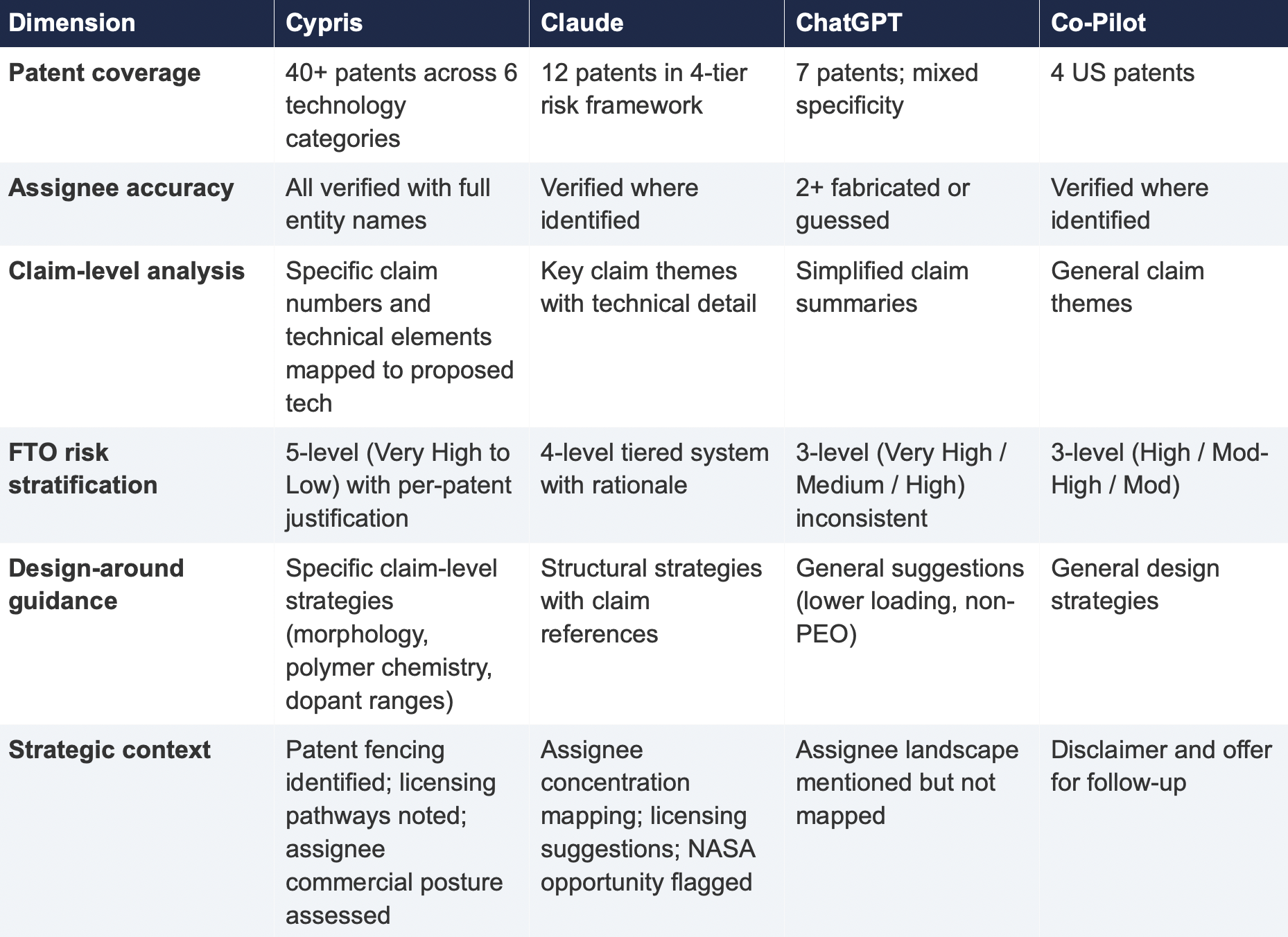
The most significant finding is the scale of the coverage differential. Cypris identified over 40 active US patents and published applications spanning LLZO-polymer composite electrolytes, garnet interface modification, polymer interlayer architectures, lithium-sulfur specific filings, and adjacent ceramic composite patents. The results were organized by technology category with per-patent FTO risk ratings.
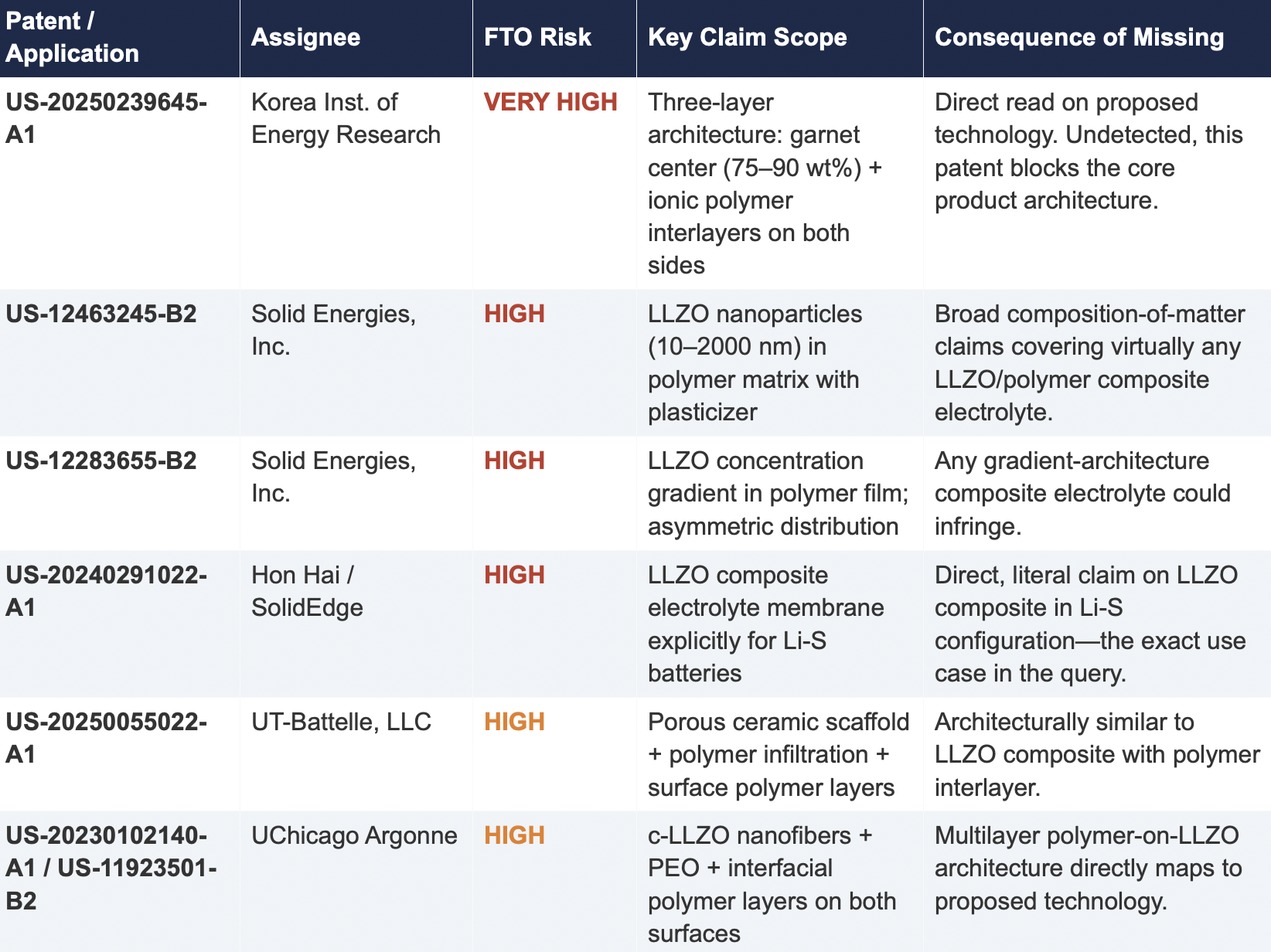
Claude identified 12 patents organized in a four-tier risk framework. Its analysis was structurally sound and correctly flagged the two highest-risk filings (Solid Energies US 11,967,678 and the LLZO nanofiber multilayer US 11,923,501). It also identified the University ofMaryland/ Wachsman portfolio as a concentration risk and noted the NASA SABERS portfolio as a licensing opportunity. However, it missed the majority of the landscape, including the entire Corning portfolio, GM's interlayer patents, theKorea Institute of Energy Research three-layer architecture, and the HonHai/SolidEdge lithium-sulfur specific filing.
ChatGPT identified 7 patents, but the quality of attribution was inconsistent. It listed assignees as "Likely DOE /national lab ecosystem" and "Likely startup / defense contractor cluster" for two filings—language that indicates the model was inferring rather than retrieving assignee data. In a freedom-to-operate context, an unverified assignee attribution is functionally equivalent to no attribution, as it cannot support a licensing inquiry or risk assessment.
Co-Pilot identified 4 US patents. Its output was the most limited in scope, missing the Solid Energies portfolio entirely, theUMD/ Wachsman portfolio, Gelion/ Johnson Matthey, NASA SABERS, and all Li-S specific LLZO filings.
2.2 Critical Patents Missed by Public Models
The following table presents patents identified exclusively by Cypris that were rated as High or Very High FTO risk for the proposed technology architecture. None were surfaced by any general-purpose model.
2.3 Patent Fencing: The Solid Energies Portfolio
Cypris identified a coordinated patent fencing strategy by Solid Energies, Inc. that no general-purpose model detected at scale. Solid Energies holds at least four granted US patents and one published application covering LLZO-polymer composite electrolytes across compositions(US-12463245-B2), gradient architectures (US-12283655-B2), electrode integration (US-12463249-B2), and manufacturing processes (US-20230035720-A1). Claude identified one Solid Energies patent (US 11,967,678) and correctly rated it as the highest-priority FTO concern but did not surface the broader portfolio. ChatGPT and Co-Pilot identified zero Solid Energies filings.
The practical significance is that a company relying on any individual patent hit would underestimate the scope of Solid Energies' IP position. The fencing strategy—covering the composition, the architecture, the electrode integration, and the manufacturing method—means that identifying a single design-around for one patent does not resolve the FTO exposure from the portfolio as a whole. This is the kind of strategic insight that requires seeing the full picture, which no general-purpose model delivered
2.4 Assignee Attribution Quality
ChatGPT's response included at least two instances of fabricated or unverifiable assignee attributions. For US 11,367,895 B1, the listed assignee was "Likely startup / defense contractor cluster." For US 2021/0202983 A1, the assignee was described as "Likely DOE / national lab ecosystem." In both cases, the model appears to have inferred the assignee from contextual patterns in its training data rather than retrieving the information from patent records.
In any operational IP workflow, assignee identity is foundational. It determines licensing strategy, litigation risk, and competitive positioning. A fabricated assignee is more dangerous than a missing one because it creates an illusion of completeness that discourages further investigation. An R&D team receiving this output might reasonably conclude that the landscape analysis is finished when it is not.
3. Structural Limitations of General-Purpose Models for Patent Intelligence
3.1 Training Data Is Not Patent Data
Large language models are trained on web-scraped text. Their knowledge of the patent record is derived from whatever fragments appeared in their training corpus: blog posts mentioning filings, news articles about litigation, snippets of Google Patents pages that were crawlable at the time of data collection. They do not have systematic, structured access to the USPTO database. They cannot query patent classification codes, parse claim language against a specific technology architecture, or verify whether a patent has been assigned, abandoned, or subjected to terminal disclaimer since their training data was collected.
This is not a limitation that improves with scale. A larger training corpus does not produce systematic patent coverage; it produces a larger but still arbitrary sampling of the patent record. The result is that general-purpose models will consistently surface well-known patents from heavily discussed assignees (QuantumScape, for example, appeared in most responses) while missing commercially significant filings from less publicly visible entities (Solid Energies, Korea Institute of EnergyResearch, Shenzhen Solid Advanced Materials).
3.2 The Web Is Closing to Model Scrapers
The data access problem is structural and worsening. As of mid-2025, Cloudflare reported that among the top 10,000 web domains, the majority now fully disallow AI crawlers such as GPTBot andClaudeBot via robots.txt. The trend has accelerated from partial restrictions to outright blocks, and the crawl-to-referral ratios reveal the underlying tension: OpenAI's crawlers access approximately1,700 pages for every referral they return to publishers; Anthropic's ratio exceeds 73,000 to 1.
Patent databases, scientific publishers, and IP analytics platforms are among the most restrictive content categories. A Duke University study in 2025 found that several categories of AI-related crawlers never request robots.txt files at all. The practical consequence is that the knowledge gap between what a general-purpose model "knows" about the patent landscape and what actually exists in the patent record is widening with each training cycle. A landscape query that a general-purpose model partially answered in 2023 may return less useful information in 2026.
3.3 General-Purpose Models Lack Ontological Frameworks for Patent Analysis
A freedom-to-operate analysis is not a summarization task. It requires understanding claim scope, prosecution history, continuation and divisional chains, assignee normalization (a single company may appear under multiple entity names across patent records), priority dates versus filing dates versus publication dates, and the relationship between dependent and independent claims. It requires mapping the specific technical features of a proposed product against independent claim language—not keyword matching.
General-purpose models do not have these frameworks. They pattern-match against training data and produce outputs that adopt the format and tone of patent analysis without the underlying data infrastructure. The format is correct. The confidence is high. The coverage is incomplete in ways that are not visible to the user.
4. Comparative Output Quality
The following table summarizes the qualitative characteristics of each tool's response across the dimensions most relevant to an operational IP workflow.
5. Implications for R&D and IP Organizations
5.1 The Confidence Problem
The central risk identified by this study is not that general-purpose models produce bad outputs—it is that they produce incomplete outputs with high confidence. Each model delivered its results in a professional format with structured analysis, risk ratings, and strategic recommendations. At no point did any model indicate the boundaries of its knowledge or flag that its results represented a fraction of the available patent record. A practitioner receiving one of these outputs would have no signal that the analysis was incomplete unless they independently validated it against a comprehensive datasource.
This creates an asymmetric risk profile: the better the format and tone of the output, the less likely the user is to question its completeness. In a corporate environment where AI outputs are increasingly treated as first-pass analysis, this dynamic incentivizes under-investigation at precisely the moment when thoroughness is most critical.
5.2 The Diversification Illusion
It might be assumed that running the same query through multiple general-purpose models provides validation through diversity of sources. This study suggests otherwise. While the four tools returned different subsets of patents, all operated under the same structural constraints: training data rather than live patent databases, web-scraped content rather than structured IP records, and general-purpose reasoning rather than patent-specific ontological frameworks. Running the same query through three constrained tools does not produce triangulation; it produces three partial views of the same incomplete picture.
5.3 The Appropriate Use Boundary
General-purpose language models are effective tools for a wide range of tasks: drafting communications, summarizing documents, generating code, and exploratory research. The finding of this study is not that these tools lack value but that their value boundary does not extend to decisions that carry existential commercial risk.
Patent landscape analysis, freedom-to-operate assessment, and competitive intelligence that informs R&D investment decisions fall outside that boundary. These are workflows where the completeness and verifiability of the underlying data are not merely desirable but are the primary determinant of whether the analysis has value. A patent landscape that captures 10% of the relevant filings, regardless of how well-formatted or confidently presented, is a liability rather than an asset.
6. Test 2: Competitive Intelligence — Bio-Based Polyamide Patent Landscape
To assess whether the findings from Test 1 were specific to a single technology domain or reflected a broader structural pattern, a second query was submitted to all four tools. This query shifted from freedom-to-operate analysis to competitive intelligence, asking each tool to identify the top 10organizations by patent filing volume in bio-based polyamide synthesis from castor oil derivatives over the past three years, with summaries of technical approach, co-assignee relationships, and portfolio trajectory.
6.1 Query

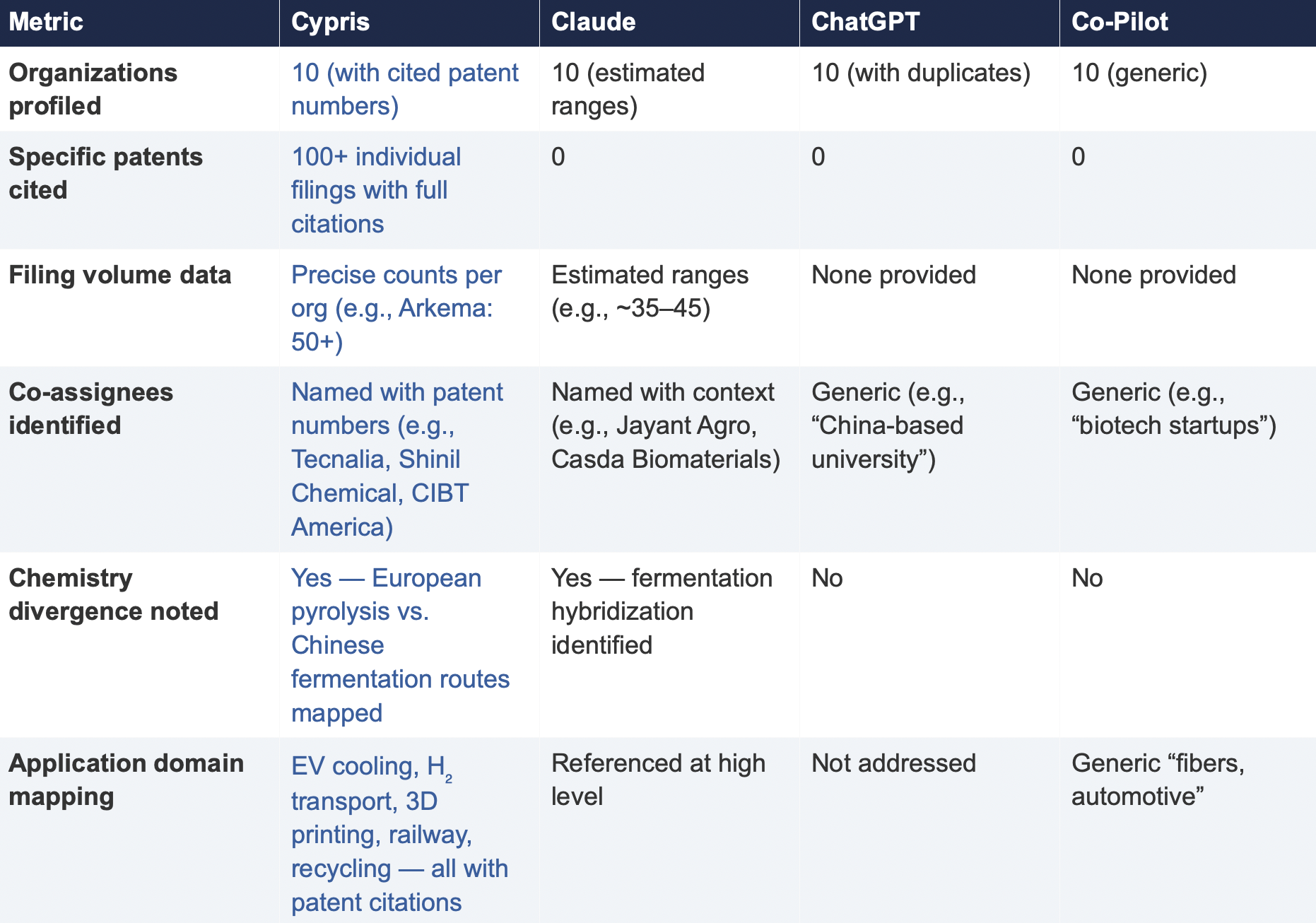
6.2 Summary of Results
6.3 Key Differentiators
Verifiability
The most consequential difference in Test 2 was the presence or absence of verifiable evidence. Cypris cited over 100 individual patent filings with full patent numbers, assignee names, and publication dates. Every claim about an organization’s technical focus, co-assignee relationships, and filing trajectory was anchored to specific documents that a practitioner could independently verify in USPTO, Espacenet, or WIPO PATENT SCOPE. No general-purpose model cited a single patent number. Claude produced the most structured and analytically useful output among the public models, with estimated filing ranges, product names, and strategic observations that were directionally plausible. However, without underlying patent citations, every claim in the response requires independent verification before it can inform a business decision. ChatGPT and Co-Pilot offered thinner profiles with no filing counts and no patent-level specificity.
Data Integrity
ChatGPT’s response contained a structural error that would mislead a practitioner: it listed CathayBiotech as organization #5 and then listed “Cathay Affiliate Cluster” as a separate organization at #9, effectively double-counting a single entity. It repeated this pattern with Toray at #4 and “Toray(Additional Programs)” at #10. In a competitive intelligence context where the ranking itself is the deliverable, this kind of error distorts the landscape and could lead to misallocation of competitive monitoring resources.
Organizations Missed
Cypris identified Kingfa Sci. & Tech. (8–10 filings with a differentiated furan diacid-based polyamide platform) and Zhejiang NHU (4–6 filings focused on continuous polymerization process technology)as emerging players that no general-purpose model surfaced. Both represent potential competitive threats or partnership opportunities that would be invisible to a team relying on public AI tools.Conversely, ChatGPT included organizations such as ANTA and Jiangsu Taiji that appear to be downstream users rather than significant patent filers in synthesis, suggesting the model was conflating commercial activity with IP activity.
Strategic Depth
Cypris’s cross-cutting observations identified a fundamental chemistry divergence in the landscape:European incumbents (Arkema, Evonik, EMS) rely on traditional castor oil pyrolysis to 11-aminoundecanoic acid or sebacic acid, while Chinese entrants (Cathay Biotech, Kingfa) are developing alternative bio-based routes through fermentation and furandicarboxylic acid chemistry.This represents a potential long-term disruption to the castor oil supply chain dependency thatWestern players have built their IP strategies around. Claude identified a similar theme at a higher level of abstraction. Neither ChatGPT nor Co-Pilot noted the divergence.
6.4 Test 2 Conclusion
Test 2 confirms that the coverage and verifiability gaps observed in Test 1 are not domain-specific.In a competitive intelligence context—where the deliverable is a ranked landscape of organizationalIP activity—the same structural limitations apply. General-purpose models can produce plausible-looking top-10 lists with reasonable organizational names, but they cannot anchor those lists to verifiable patent data, they cannot provide precise filing volumes, and they cannot identify emerging players whose patent activity is visible in structured databases but absent from the web-scraped content that general-purpose models rely on.
7. Conclusion
This comparative analysis, spanning two distinct technology domains and two distinct analytical workflows—freedom-to-operate assessment and competitive intelligence—demonstrates that the gap between purpose-built R&D intelligence platforms and general-purpose language models is not marginal, not domain-specific, and not transient. It is structural and consequential.
In Test 1 (LLZO garnet electrolytes for Li-S batteries), the purpose-built platform identified more than three times as many patents as the best-performing general-purpose model and ten times as many as the lowest-performing one. Among the patents identified exclusively by the purpose-built platform were filings rated as Very High FTO risk that directly claim the proposed technology architecture. InTest 2 (bio-based polyamide competitive landscape), the purpose-built platform cited over 100individual patent filings to substantiate its organizational rankings; no general-purpose model cited as ingle patent number.
The structural drivers of this gap—reliance on training data rather than live patent feeds, the accelerating closure of web content to AI scrapers, and the absence of patent-specific analytical frameworks—are not transient. They are inherent to the architecture of general-purpose models and will persist regardless of increases in model capability or training data volume.
For R&D and IP leaders, the practical implication is clear: general-purpose AI tools should be used for general-purpose tasks. Patent intelligence, competitive landscaping, and freedom-to-operate analysis require purpose-built systems with direct access to structured patent data, domain-specific analytical frameworks, and the ability to surface what a general-purpose model cannot—not because it chooses not to, but because it structurally cannot access the data.
The question for every organization making R&D investment decisions today is whether the tools informing those decisions have access to the evidence base those decisions require. This study suggests that for the majority of general-purpose AI tools currently in use, the answer is no.
Study Disclosure
This comparative evaluation was commissioned and published by Cypris. The testing methodology, prompts, evaluation criteria, and underlying outputs have been documented to support independent review and replication.
All platform outputs were preserved in their original form. Patent data and material factual claims were cross-checked against USPTO Patent Center and WIPO PATENTSCOPE records as of March 27, 2026. Cypris was one of the platforms evaluated and therefore has a commercial interest in the findings.
The Patent Intelligence Gap - A Comparative Analysis of Verticalized AI-Patent Tools vs. General-Purpose Language Models for R&D Decision-Making
Blogs

A freedom-to-operate search answers a specific question: can a company make, use, or sell a product without infringing someone else's active patent claims. This differs from a novelty or prior art search, which asks whether an invention is new. FTO asks whether launching it is safe, and getting the answer wrong carries direct commercial risk, not just a delayed filing.
The consequences of an incomplete FTO analysis are not abstract. Patent infringement verdicts routinely reach into the hundreds of millions of dollars, and a single missed blocking patent can force a hardware redesign, a halted product line, or years of litigation over technology that could have been designed around during development. For a mid-size company, a university spinout, or any organization without a large in-house IP function, a nine-figure verdict or a multi-year injunction is not a survivable event. The FTO analysis conducted during development is often the only real risk mitigation mechanism a program has.
A growing share of that analysis is now being run with general-purpose AI tools that were never built for it. These tools reason from training data rather than a live patent record, so their outputs adopt the format and tone of an FTO report without the underlying data infrastructure to support it. The result is a specific and dangerous failure mode: an incomplete analysis delivered with high confidence, with no signal to the reader that the coverage is partial. A team that treats that output as a finished FTO clearance is taking on risk it cannot see.
How to run an AI-powered FTO report
A rigorous AI-powered FTO analysis moves through several linked steps, and the quality of the output depends on how carefully each one is done, not just on which model is generating the summary. The most reliable version of this process runs as an agentic workflow: rather than a single prompt, a sequence of connected steps that search, verify, and stratify against a live patent record, ideally over a structured R&D ontology and connected to the patent data through a protocol such as MCP (the Model Context Protocol).
The first step is defining the product or process precisely enough to search against. A vague description produces a vague search. The scope should specify the technical architecture, the materials or methods involved, and the specific claims of function the product makes, since claim-level FTO risk is assessed against exactly this level of detail, not a general category description.
The second step is running that scope against the patent corpus at the level of the claims themselves, not a keyword index. Claim language is technical and often uses different terminology across different filings for the same underlying concept, so a search that only matches literal keywords will miss patents that a human examiner would immediately recognize as relevant. A capable AI-powered search reads claim text semantically and against the scope's technical features, rather than pattern-matching surface language.
The third step is verifying every result against a real, current legal record: assignee, filing date, publication status, and whether a patent is active, abandoned, or subject to a terminal disclaimer. This is the step where general-purpose AI tools fail most visibly. A model reasoning from training data will sometimes infer an assignee rather than retrieve it, producing plausible-looking attributions that are not actually verifiable. In an FTO context, an unverified assignee is functionally equivalent to no assignee, since it cannot support a licensing inquiry or a risk assessment.
The fourth step is risk stratification, not a flat list of matches. A useful FTO report groups results by risk level, distinguishing patents whose claims directly read on the proposed product from patents that are only tangentially related. It should also surface portfolio-level patterns, since a single company sometimes files a coordinated set of patents covering a composition, an architecture, and a manufacturing method for the same underlying technology. Clearing one patent in that set does not resolve exposure to the portfolio as a whole, and a report that only lists individual hits without connecting them will understate real risk.
The fifth step is monitoring the result afterward, not treating it as a one-time report. An FTO position reflects the patent landscape at the moment the search was run, and new filings can change that picture before a product actually launches, particularly on programs with long development timelines. A cleared position from eighteen months ago is not the same as a cleared position today.
Where Cypris fits
Cypris treats freedom-to-operate as one stage in a connected R&D decision process rather than an isolated search task. It runs on a corpus of more than 500 million patents and scientific papers organized through a proprietary R&D ontology, so an FTO query surfaces claim-level risk across a full technology landscape rather than a list of patents that happen to share keywords with a product description. Because the ontology drives semantic search, a blocking patent that describes the same underlying claim in different terminology is surfaced rather than missed. Cypris Q, the platform's agentic layer, runs FTO agents that flag blocking risk directly and connect that assessment to the prior art and white space work that typically precedes an FTO decision, so a team moves through the full stage-gate process in one environment as an agentic workflow rather than a set of disconnected searches. Cypris pairs FTO assessment with Agentic Monitoring, so a cleared freedom-to-operate position continues to be tracked as new filings enter the space rather than going stale the moment the initial report is delivered. Cypris is reachable through MCP (the Model Context Protocol), so FTO analysis can run inside the AI clients an R&D or IP team already uses. Cypris meets enterprise-grade security requirements and serves hundreds of enterprise customers across pharmaceuticals, chemicals, advanced materials, and other regulated industries.
How to choose FTO patent search software
The deciding question is whether the assessment needs to stand alone or connect to the rest of an R&D decision. Legacy, patent-centric analytics platforms provide credible FTO analysis for a defined product or process, built primarily for IP professionals running structured, deliberate searches. A platform built for continuous R&D decision-making, such as Cypris, is the better fit for teams that want FTO risk assessed as part of the same workflow as prior art and white space analysis, with the resulting position monitored afterward rather than treated as a one-time report. Given that a mistaken or incomplete FTO assessment carries direct commercial risk, the completeness and currency of the underlying data should weigh more heavily than convenience or price alone.
FAQ
**What is a freedom-to-operate (FTO) search?**
A freedom-to-operate search determines whether making, using, or selling a specific product or process would infringe another party's active patent claims in a given jurisdiction. It differs from a novelty or prior art search, which asks whether an invention is new. FTO asks whether commercializing it is legally safe.
**How do I run an AI-powered FTO report?** Define the product or process precisely, including its technical architecture and specific claims of function. Search that scope against the patent corpus at the claim level using semantic rather than keyword matching. Verify every result against a current legal record, including assignee, filing date, and legal status. Stratify results by risk level rather than listing flat matches, and check for coordinated patent filings covering the same technology from a single source. Monitor the cleared position afterward, since new filings can change the picture before launch.
**What is the best FTO patent search software?**
The strongest FTO software connects claim-level analysis to the rest of an R&D decision process rather than treating FTO as an isolated search. Cypris runs FTO assessment on a corpus of more than 500 million patents and scientific papers organized through a proprietary R&D ontology, surfacing claim-level risk and monitoring it afterward rather than delivering a one-time report.
**How is an FTO search different from a patentability search?** A patentability search asks whether an invention is novel enough to be granted a patent. An FTO search asks whether commercializing that invention would infringe someone else's existing patent, regardless of whether the invention itself is novel. An invention can be patentable and still infringe another company's active claims.
**Why is a freedom-to-operate search necessary before a product launch?**
Launching a product that infringes an active patent can result in injunctions, damages, and forced redesigns after significant investment has already been made. An FTO search conducted during development identifies blocking claims early enough to design around them, license them, or reconsider the approach before launch costs are sunk.
**Can AI tools identify all blocking patents automatically?** No FTO process guarantees complete automatic identification, and general-purpose AI tools carry a specific risk: they can produce a confident, well-formatted report while missing most of the relevant landscape, with no signal to the reader that the analysis is incomplete. Claim scope, prosecution history, and continuation chains require careful interpretation, and platforms with claim-level analysis grounded in a live patent corpus reduce that risk far more than tools reasoning from training data alone.
**Is free patent search software sufficient for an FTO clearance?**
Free patent search tools are useful for an initial, informal scan, but they provide no claim-scope analysis, risk stratification, or systematic FTO methodology. A genuine FTO clearance intended to support a product launch decision should rely on a platform or process built specifically for FTO.
**How does FTO search relate to white space and prior art analysis?** The three are linked but distinct. White space analysis identifies where a technology area is open for investment. Prior art search evaluates whether a specific invention is novel. FTO search evaluates whether commercializing a specific, already-defined product risks infringing existing claims. Teams typically move through white space, then prior art, then FTO as a program advances toward launch.
**Can AI agents run a freedom-to-operate analysis?**
AI agents can run much of an FTO analysis when they are grounded in a live patent record rather than training data. An agentic workflow can define the scope, run semantic search over a structured R&D ontology, verify results against the legal record, and stratify risk as connected steps rather than a single prompt. Connecting those agents to patent data through a protocol such as MCP (the Model Context Protocol) lets the analysis run inside an existing AI client, though high-stakes launches still benefit from expert review.
**Should FTO risk be monitored after the initial assessment?** Yes. A freedom-to-operate position reflects the patent landscape at the time of the search, and new filings can change that picture before a product actually launches, particularly for programs with long development timelines. Platforms that pair FTO assessment with ongoing monitoring keep a cleared position current rather than treating it as a one-time report.
What an MCP server is, how the Model Context Protocol connectsAI assistants to patent and scientific literature databases, and how Cyprisuses MCP to deliver R&D intelligence.
AnAI assistant cannot reach live patent data on its own. Every patent searchquestion requires manual work first: pull the patent family from a database,copy the claims into the chat, ask the question, copy the answer elsewhere. TheModel Context Protocol, or MCP, removes that manual step. MCP lets an AIassistant connect directly to external data sources during a conversation.
What MCP is
MCPis an open standard for connecting AI assistants to external data sources andtools. Anthropic introduced MCP in November 2024. A data source, such as apatent database or a scientific literature index, exposes itself through an MCPserver. Any MCP-compatible AI client, including Claude Desktop and ChatGPTDesktop, can connect to that server and use it directly.
BeforeMCP, connecting an AI assistant to a specific database required a customintegration for each assistant and each data source. MCP standardizes thatconnection. One server, built once, works with any MCP-compatible client.
AnMCP server exposes three things to a connected AI client: tools it can call,such as a patent search function; resources it can read, such as patent recordsor paper abstracts; and prompts that template common tasks. A connected AIassistant can call a tool mid-conversation, retrieve current data, and answerbased on that data. It does not have to rely only on what it learned duringtraining.
Why MCP matters for patent search
Patentand scientific literature data changes constantly. A patent landscape shiftswith every new filing. A freedom-to-operate risk can appear the week before aproduct launch. A relevant paper can publish while a literature review isunderway. An AI assistant reasoning only from training data cannot know aboutany of this. It also cannot flag that its answer might be incomplete.
Patentdata is structured and authoritative. Assignee, filing date, legal status, andclaim language are facts recorded in a system of record: USPTO, EPO, WIPO.These facts do not benefit from being paraphrased from a webpage that oncementioned them. MCP lets an AI assistant query the system of record directly.It can cite exactly what it found, inside the same conversation where theanalysis is happening.
How MCP is used in patent search and R&D workflows
Aresearcher using an MCP-connected AI client can describe an invention in plainlanguage. The assistant searches live patent and literature sources directly.No query translation step is required. An IP analyst can ask about a specificassignee's recent filing activity and get an answer sourced from a current APIcall, not from training data. A scientist reviewing a technology area can pullrecent papers, patents, and citation relationships into the same conversationwhere a landscape summary is being drafted.
TheAI assistant stops operating next to the data. It starts operating on the datadirectly. Output quality depends on what data the assistant can reach throughits connected MCP server.
Where open-source MCP servers are useful, and where they stop beingenough
Open-sourceMCP servers connect AI clients to major patent and literature sources: USPTOsearch and litigation APIs, EPO's Open Patent Services for European patentdata, Google Patents, and academic sources including arXiv, PubMed, andSemantic Scholar. For a team that needs one specific data source from onespecific AI client, these are frequently the right choice. Several are activelymaintained.
Theseconnectors answer one question against one source. They do not carry contextacross a decision. A prior art search, a white space analysis, afreedom-to-operate assessment, and a regulatory check are linked stages of thesame decision: whether an R&D program is worth pursuing. The result of onestage should inform how the next is read. A single-source MCP server accuratelyreturns what its database contains. It has no framework for connecting a priorart result to a freedom-to-operate risk rating, because it answers one kind ofquery, not a workflow.
How Cypris uses MCP
Cyprisis an R&D intelligence platform, reachable through MCP, built on a corpusof more than 500 million patents and scientific papers organized through aproprietary R&D ontology. A connected AI client using Cypris through MCPworks with structured domain context, not raw results from a single searchendpoint.
Theagents available through Cypris's MCP server map to the stage-gate decisions anR&D or IP team makes: prior art review, white space identification,freedom-to-operate risk assessment, and regulatory tracking. Cypris Q, theplatform's agentic layer, and enterprise API partnerships with OpenAI,Anthropic, and Google make Cypris accessible inside the AI environmentsenterprise R&D and IP teams already use. Cypris meets enterprise-gradesecurity requirements and serves hundreds of enterprise customers acrosspharmaceuticals, chemicals, advanced materials, energy, and other regulated,security-conscious industries.
Asingle-source, open MCP server is the right tool for retrieval from one patentoffice or literature source inside one AI client. Cypris is built for adifferent need: an AI assistant that carries domain context across prior art,white space, freedom-to-operate, and regulatory decisions in the same workflow.
Setting up an MCP connection
Connectingan MCP-compatible AI client to a data source is a configuration step. Point theclient at the server. Authenticate if the source requires it. Its tools becomeavailable in conversation. Cypris is accessed through enterprise APIpartnerships rather than a self-hosted connection. This is what allows Cypristo meet enterprise security requirements while functioning as an MCP serverinside a team's existing AI client.
FAQ
**What is MCP?** MCP, theModel Context Protocol, is an open standard that lets an AI assistant connectdirectly to external data sources and tools during a conversation. Anthropicintroduced MCP in November 2024. MCP replaces custom, one-off integrations witha single protocol that works across MCP-compatible AI clients and MCP servers.
**Whatis an MCP server?** An MCP server is a connector, built on the Model ContextProtocol, that exposes a data source or tool to an MCP-compatible AI client.For patent search and R&D intelligence, an MCP server can expose patentdatabases, scientific literature indexes, or a broader intelligence platformlike Cypris to an AI assistant such as Claude Desktop or ChatGPT Desktop.
**How is MCP different froma standard API integration?** A standard integration is built once for oneapplication to connect to one data source. MCP standardizes the connection. AnyMCP-compatible AI client can use any MCP server without a new integration foreach pairing.
**Whydoes MCP matter for patent search?** Patent and scientific literature datachanges continuously. It is only useful when current and verifiable against asystem of record. An AI assistant reasoning from training data alone cannotreflect a recent filing. MCP lets the assistant query authoritative sourcesdirectly and answer based on what it retrieves.
**Does connecting to an MCPserver guarantee accurate patent search results?** No. MCP determines whetheran AI assistant can reach a data source in real time. It does not determine howcomplete that source is. A single-source MCP server accurately returns whatthat one source contains. That is not the same as complete patent landscapecoverage.
**Whatis the difference between an MCP connector and an R&D intelligence platformlike Cypris?** A connector answers one query against one data source. Cyprissupports a decision process where prior art, white space, freedom-to-operate,and regulatory findings inform each other. Cypris runs on a corpus of more than500 million patents and scientific papers organized through a proprietaryR&D ontology, delivered through an MCP server and enterprise APIpartnerships with OpenAI, Anthropic, and Google.
**Can Cypris be usedtogether with open-source MCP servers?** Yes. Teams often use open-source,single-source MCP connectors for specific databases alongside Cypris forworkflows that require reasoning across multiple linked patent and R&Ddecisions.
**Do I need to be a developer to use Cypris throughMCP?** No. Once Cypris is connected inside a compatible AI client, using it isa natural-language conversation. Cypris is accessed through enterprise APIpartnerships built to remove setup
Green ammonia has become a priority for industrial decarbonization, and its patent landscape is distinctive because low-carbon ammonia is being pursued through several competing routes, each with its own chemistry and process engineering. Ammonia is one of the highest-volume chemicals made, the foundation of nitrogen fertilizer, and a candidate hydrogen carrier and fuel, and its conventional production, reforming fossil methane for hydrogen and combining it with nitrogen in the high-temperature, high-pressure Haber-Bosch process, is carbon-intensive: the International Energy Agency attributes to ammonia production roughly 1.3 percent of energy-system carbon dioxide emissions and about 2 percent of total final energy consumption, with direct carbon dioxide emissions on the order of 450 million tonnes a year.¹ Decarbonizing it is therefore a climate priority, and the routes divide into distinct regions of patenting: renewable-powered Haber-Bosch, which replaces fossil hydrogen with hydrogen from water electrolysis and feeds a modified synthesis loop;⁴ direct electrochemical nitrogen reduction, which converts nitrogen to ammonia electrochemically under mild conditions;²,⁵ plasma-electrocatalysis; nitrogen-oxide reduction; and solid-oxide electrochemical cells. Cutting across the routes are the catalysts, the electrode and cell designs, and the process control that adapts synthesis to variable renewable power. Because a competitive process depends on several of these, freedom-to-operate and white space analysis must span the routes and the layers together.
The landscape is being pulled forward by decarbonization and by the sheer scale of demand, so even incremental efficiency and emission gains are valuable. The routes sit at very different stages: renewable-powered Haber-Bosch is the most commercially mature and holds the largest share of patent activity, with established engineering firms filing on integrating intermittent hydrogen supply, buffer storage, and dynamic synthesis-loop control, while direct electrochemical, plasma, and solid-oxide routes are earlier, advancing rapidly in catalyst design and device operation but still facing fundamental efficiency and selectivity limits. Theoretical analysis places the maximum energy efficiency of the leading lithium-mediated electrochemical process at roughly 28 percent, and scaling relations among reaction intermediates constrain how selective nitrogen-to-ammonia catalysts can be, which is why catalyst design is the central research problem for these routes.³,⁷ This shows in the record: across the Cypris corpus of more than 500 million patents and scientific papers, the green and electrochemical ammonia set holds on the order of 3,613 families and grew from about 155 in 2020 to roughly 523 in 2024, with the most active assignees led by established ammonia-technology licensors such as Topsoe and Casale alongside energy majors, and China well ahead of the United States and Denmark on geography; 2025 and 2026 counts are partial because of the publication lag.
The strategic question is which route and layer to back, and the white space sits where the chemistry is hardest. In renewable-powered Haber-Bosch, the open ground is in dynamic operation and process integration that let a plant follow variable renewable power. In the electrochemical routes, catalysts that raise ammonia yield and suppress the competing hydrogen-evolution reaction are the central problem, and they are comparatively open and high-value.²,⁵ Plasma-electrocatalysis and solid-oxide cells are earlier, less-crowded routes, and modular, decentralized designs are strategically important where distributed fertilizer and fuel production matter.⁶ Reading the landscape by route, catalyst, and process, and tracking both the patents and the underlying catalysis research, is what separates a crowded region from an open one.
Where the green-ammonia white space is
Nitrogen-reduction catalysts. Catalysts that raise ammonia yield and suppress the competing hydrogen-evolution reaction are the central problem for the electrochemical route and a comparatively open, high-value layer.²,⁵
Dynamic, flexible Haber-Bosch. Process control and loop designs that let a synthesis plant follow variable renewable power are a large, active layer in the most mature route.⁴
Plasma-electrocatalysis and solid-oxide cells. These earlier routes, including intermediate-temperature solid-oxide electrochemical cells, are less crowded and offer differentiated positions.
Nitrogen-oxide-mediated routes. Pathways that route through nitrogen-oxide intermediates are an emerging, distinct area of chemistry.
Modular, decentralized systems. Small-scale, modular ammonia production near renewable resources and demand is a strategically important system layer.⁶
How AI-powered landscape and white space analysis helps
Resolving a landscape that spans several synthesis routes, each with its own catalysts and process, requires more than keyword search. AI-powered analysis addresses this with semantic search that clusters activity by route, catalyst, and process across varied terminology, attribution that normalizes engineering-firm, startup, and academic filers to canonical entities, and continuous monitoring that keeps pace with a decarbonization-driven surge. Because ammonia-synthesis advances appear in scientific and catalysis literature before they are patented, reading both patents and literature gives the earliest signal of where scalable routes are emerging.
Where Cypris fits
Cypris runs patent landscape and white space analysis for multi-route chemical fields such as green ammonia across a corpus of more than 500 million patents and scientific papers, organized through a proprietary R&D ontology. The ontology clusters activity by route, renewable Haber-Bosch, electrochemical nitrogen reduction, plasma, nitrogen-oxide, and solid-oxide, and by layer, catalyst, cell and electrode, and process control, and normalizes engineering-firm, startup, and academic filers to canonical entities, so a team can resolve which routes and layers are crowded and which remain open as white space, and can track new entrants as the field scales. Semantic search across patents and scientific literature connects filings to the underlying catalysis research, which is where green-ammonia advances appear first. Cypris Q, the platform's agentic layer, lets teams run landscape and white space analysis conversationally and chain the clustering, attribution, and gap analysis, and Agentic Monitoring tracks a defined route over time and flags new patents and papers as they publish. Cypris provides enterprise API partnerships with OpenAI, Anthropic, and Google, and is built with enterprise-grade security. Cypris serves hundreds of enterprise customers across pharmaceuticals, chemicals, advanced materials, energy, and other regulated industries.
FAQ
What is the green ammonia patent landscape? The green ammonia patent landscape is the set of patents covering low-carbon ammonia production. It divides across competing routes, renewable-powered Haber-Bosch, direct electrochemical nitrogen reduction, plasma-electrocatalysis, nitrogen-oxide reduction, and solid-oxide electrochemical cells, each with distinct catalysts and process IP. Each route is a distinct region of patenting.
Why is green ammonia a decarbonization priority? Green ammonia is a decarbonization priority because ammonia is one of the largest-volume chemicals, the backbone of fertilizer, and a candidate fuel and hydrogen carrier, while its conventional production is fossil-fuel-based. The International Energy Agency attributes to it roughly 1.3 percent of energy-system carbon dioxide emissions and about 2 percent of final energy use. Decarbonizing it addresses both food and energy systems.
What routes does the green-ammonia landscape cover? The landscape covers renewable-powered Haber-Bosch, direct electrochemical nitrogen reduction, plasma-electrocatalysis, nitrogen-oxide reduction, and solid-oxide electrochemical cells. Each uses different chemistry and sits at a different maturity, with renewable Haber-Bosch the most commercially advanced. Freedom-to-operate and white space analysis must treat them separately.
Where is the white space in green ammonia? The white space includes nitrogen-reduction catalysts, dynamic and flexible Haber-Bosch operation, plasma-electrocatalysis and solid-oxide cells, nitrogen-oxide-mediated routes, and modular decentralized systems. Renewable Haber-Bosch is comparatively mature and holds the most patents. The most open, high-value opportunities are in electrochemical catalysts and the earlier routes.
Why are nitrogen-reduction catalysts so important? Nitrogen-reduction catalysts are important because the direct electrochemical route's viability depends on raising ammonia yield while suppressing the competing hydrogen-evolution reaction, which otherwise dominates, and because scaling relations among intermediates limit selectivity. Solving this is the central technical problem for that route. The catalyst compositions and cell designs that achieve it are foundational and defensible.
Why does green-ammonia analysis need scientific literature? Green-ammonia analysis needs scientific literature because catalyst and cell advances appear in chemistry research before they are patented, so the literature gives the earliest signal. Analyzing patents alone gives a lagging view. Cypris analyzes both across more than 500 million patents and scientific papers.
What software helps analyze the green ammonia patent landscape? Software for the green-ammonia landscape should cluster activity by route and process layer, resolve engineering-firm, startup, and academic filers to canonical owners, search patents and scientific literature semantically, and monitor a decarbonization-driven field continuously. Cypris does this across more than 500 million patents and scientific papers using a proprietary R&D ontology, semantic search, Cypris Q, and Agentic Monitoring.
Which teams use green ammonia patent landscape analysis? Green ammonia patent landscape analysis is used by R&D, innovation, IP, and strategy teams at chemical, fertilizer, energy, and engineering companies, catalysis developers, and their partners, as well as investors and policymakers. It informs which route to back, where to file, and where competitors are concentrated. Cypris serves hundreds of enterprise customers across chemicals, energy, advanced materials, and other regulated industries.
Endnotes
- International Energy Agency (2021). Ammonia Technology Roadmap. https://www.iea.org/reports/ammonia-technology-roadmap
- Li, S., et al. (2021). Electrochemical ammonia synthesis: mechanistic understanding and catalyst design. Chem, 7(12). https://doi.org/10.1016/j.chempr.2021.01.009
- Fu, X., Zhou, Y., Nørskov, J. K., & Chorkendorff, I. (2024). Electrochemical ammonia synthesis: the energy efficiency challenge. ACS Energy Letters, 9(12). https://doi.org/10.1021/acsenergylett.4c02954
- Gu, Y., et al. (2024). Ambient electrochemical ammonia synthesis: from theoretical guidance to catalyst design. Advanced Science, 11. https://doi.org/10.1002/advs.202308979
- Sankannavar, A., & Shetty, A. (2024). Exploring nitrogen reduction reaction mechanisms in electrochemical ammonia synthesis: a comprehensive review. Journal of Energy Chemistry, 92. https://doi.org/10.1016/j.jechem.2024.01.024
- Chebrolu, V. T., et al. (2023). Overview of emerging catalytic materials for electrochemical green ammonia synthesis. Carbon Energy, 5. https://doi.org/10.1002/cey2.361
- Tsai, C., Vojvodić, A., Montoya, J., & Nørskov, J. K. (2015). The challenge of electrochemical ammonia synthesis: nitrogen scaling relations. ChemSusChem, 8(13). https://doi.org/10.1002/cssc.201500322
Reports
This Cypris research brief maps the full ecosystem and value chain of electric vehicle battery systems and advanced battery materials, tracing the pathway from raw material extraction through precursor and active material production, cell component manufacturing, battery cell production, pack assembly, vehicle integration, and end-of-life recycling. The brief defines each segment's functional role, identifies key players across upstream, midstream, and downstream layers, and analyzes the structural forces — including critical mineral supply volatility, geographic concentration, OEM vertical integration strategies, recycling-driven circularity, and solid-state battery development — that are reshaping where value concentrates and where supply-chain risk resides.
This Cypris research brief maps the ecosystem and value chain of the specialty polymers and high-performance materials industry, covering the full pathway from raw material and monomer suppliers through polymer manufacturers, compounders, additive suppliers, specialty distributors, converters, and end-use OEMs across aerospace, automotive, electronics, medical, energy, and industrial markets. Beyond the segment-by-segment breakdown and player landscape, the brief analyzes the structural forces shaping the ecosystem — including vertical integration strategies, supplier concentration and consolidation patterns, geographic clustering, circularity constraints, and shifting end-market demand — with a central thesis that leverage in this ecosystem concentrates wherever technical specialization overlaps with requalification burden.
Cypris Research Services' inaugural Innovation Outlook examines how AI-driven data center demand is reshaping U.S. power infrastructure — and why hyperscalers have stopped waiting for the grid to catch up. The report synthesizes commercial activity, market sizing, technology trends, and patent-based competitive positioning into a single ecosystem view of behind-the-meter generation, sizing the U.S. opportunity at $35.8B and tracking 56 GW of contracted bypass capacity already in the pipeline. It identifies where the defensible whitespace actually sits — and it's not where most of the market is currently looking.
Webinars
.png)

Most IP organizations are making high-stakes capital allocation decisions with incomplete visibility – relying primarily on patent data as a proxy for innovation. That approach is not optimal. Patents alone cannot reveal technology trajectories, capital flows, or commercial viability.
A more effective model requires integrating patents with scientific literature, grant funding, market activity, and competitive intelligence. This means that for a complete picture, IP and R&D teams need infrastructure that connects fragmented data into a unified, decision-ready intelligence layer.
AI is accelerating that shift. The value is no longer simply in retrieving documents faster; it’s in extracting signal from noise. Modern AI systems can contextualize disparate datasets, identify patterns, and generate strategic narratives – transforming raw information into actionable insight.
Join us on Thursday, April 23, at 12 PM ET for a discussion on how unified AI platforms are redefining decision-making across IP and R&D teams. Moderated by Gene Quinn, panelists Marlene Valderrama and Amir Achourie will examine how integrating technical, scientific, and market data collapses traditional silos – enabling more aligned strategy, sharper investment decisions, and measurable business impact.
Register here: https://ipwatchdog.com/cypris-april-23-2026/
.png)
In this session, we break down how AI is reshaping the R&D lifecycle, from faster discovery to more informed decision-making. See how an intelligence layer approach enables teams to move beyond fragmented tools toward a unified, scalable system for innovation.
In this session, we explore how modern AI systems are reshaping knowledge management in R&D. From structuring internal data to unlocking external intelligence, see how leading teams are building scalable foundations that improve collaboration, efficiency, and long-term innovation outcomes.
.avif)